Tuesday, June 5, 2012

From Brownfield to Greenfield

Liberty Lands Park.
It’s hard to tell that the two acre parcel that is now Liberty Lands Park in Philadelphia was once an industrial brownfield. And it's hard to believe that the surrounding Northern Liberties community used to be one of the only neighborhoods in Philadelphia without a public green space. Liberty Lands is now a vibrant, essential part of that community, and a symbol of what resourceful neighbors can do with a few shovels, some environmental know-how, and a commitment to making their community a better place.

What is now a park, community garden, playground and state-of-the-art model for water management was once the Burk Brothers Tannery. This former brownfield or contaminated land was made safe and usable after the hazardous materials were removed by the Environmental Protection Agency in 1987.

After the pollution from the tannery was cleaned up and the contaminated materials were subtracted, biosolids, or nutrient-rich organic materials that are a bi-product from treatment of sewage at water treatment facilities, were used to improve the quality of the land. Biosolids act as a natural fertilizer, enabling the soil to retain more water and nutrients and made it possible for the growth of a community garden, an herb garden, and the more than 180 trees that the park now features.

In 1995, a development company planned to convert the land into loft apartments. When the deal fell through, the land was donated to Northern Liberties Neighborhood Association (NLNA). Since the community didn’t have a green space, neighbors envisioned and created designs for a park. In 1996, the NLNA and the project received funding from the Philadelphia Urban Resources Project.


Trail at Liberty Lands Park

Flowers in full bloom.

By the spring of 1997, with the help of other generous donations and volunteer labor, Liberty Lands was born. The park now has partnerships with Philadelphia Urban Resources Project, the Pennsylvania Horticulture Society (PHS), Philadelphia Water Department, Pennsylvania Department of Environment Protection (PA-DEP), TreeVitalize, and the Philadelphia Mural Arts Program.

More recently, the park was selected for a storm water management project. The PHS designed the project and was funded by Philadelphia Water Department/PA-DEP with the aim of easing loads on local waste water systems. Additional community support has funded the instillation of a cistern that will allow for water efficiency and conservation as water will be diverted towards irrigation.

The storm water management system establishes methods that could be utilized across the city and once again demonstrates how Liberty Lands is a model of a sustainable green space and an excellent example of grassroots community building. (See more on Philadelphia's innovative new storm-water management and green infrastructure programs at our previous posts at Home Science and Designer In Exile).


Children's garden.
Green Infrastructure landscaping.

A Few Words with Liberty Lands Park Coordinator Liz Reed.

Many people have pitched in to turn the Northern Liberties lots into a green space. Among them is park coordinator Liz Long Reed. She and her husband William Reed, co-owner of the popular restaurant, pub, and entertainment venues The Standard Tap and Johnny Brenda's, have a great history putting together fun events at the park. Recently we chatted with Liz about her related experiences:


What do you think is the single most significant function of Liberty Lands?

I think the thing that makes Liberty Lands special is that it is versatile. It's lots of things to lots of people. Even with the addition of the stage and rain garden, we purposely thought about how it would be used when there wasn't a major music or rain event going on. We want people to explore and hang out in that area.

What, if anything, has been the biggest hindrance in making Liberty Lands what it is today?

I suppose that would be lack of funds. Regardless, I think we make the most of our time and our volunteers to keep the park safe and looking its best.

What is your favorite part of the park?

That would have to be where I get to sit back and just enjoy it with my neighbors. A close second is that we own it. If we find the ways and the means to make stuff happen, we can do what we want. Like today, my husband/dedicated park volunteer went out with three extension cords and a giant drill to fix a planter that some enthusiastic bunch tipped over and broke last year. Our neighbor will meet him later in the week with his bobcat to pick the heavy top up and place it so it can be re-cemented in place. It's our park, so we can be as creative with our time and energies as we see fit. It's like a big common back yard.

Does the Northern Liberties Neighborhood Association have any new plans in store for the park or any other other green spaces in the area?

Yes to both. We hope to build a "potty shed." A neighbor designed it to house a port-a-potty on one side and a tool shed on the other. The idea is that people then can pay an annual fee to get the combo to use the toilet, and the fees cover the maintenance contract. If, for whatever reason, it doesn't work out, then we end up with one big shed.

In addition, the NLNA got a grant to green the area from 2nd Street to Delaware Avenue along Spring Garden Street. This includes planting 50 trees on April 17th. And the Philadelphia Water Department and Philadelphia Horticulture Society have started revamping the Dough-boy pocket park at 2nd and Spring Garden as we speak. It will include new storm-water amenities.


This article was posted previously on our sister site Designer In Exile.
Enhanced by Zemanta

Tuesday, April 17, 2012

The Earthmaker

 
A local entrepreneur shows how to make a buck while making a difference with his innovative composting business.


Tim Bennett
Tim Bennett is a shrewd businessman. His schooling and work with Temple's Fox School of Business added to his natural propensity for success. But to him, developing a good business meant going a step beyond just monetary gain. He also wanted a company with redeeming social value. With a recent honorary business award under his belt, and presentations at local enterprise forums, he's sharing his knowledge of what it takes to build a sustainable business in Philadelphia. Home Science caught up for a quick word from him as well:
   
Tell us about Bennett Compost. How long have you been in operation and how did you get your start? And what services do you offer?

I started Bennett Compost in summer of 2009. We started with a focus on residential composting. It was a needed solution because if you live in a city with limited space, it's difficult to find an easy way to compost. And we wanted to help people do that.

I was doing the business part time, while working full time. After about 10 months, I was able to leave my full time job and do Bennett Compost full time. At that point we started to add commercial business as well, not just helping residents compost but helping businesses, restaurants, supermarkets, grocery stores, coffee shops - anyone who was producing food - to compost their food waist as well.

What is the general process involved in composting. Where does it go? And what does the customer get back in return?

Composting is a very natural process where you're combining nitrogen rich organic food waste with carbon rich organic waste such as leaves or wood wastes, saw dust - anything like that.

We do our composting in a couple of different ways. What we collect from our customers in the residential stuff, we compost ourselves and through a network of community gardens that are established in the city, mostly in South Philadelphia, but one or two in North Philadelphia as well.

For most of the commercial stuff we work with a farm in Montgomery County, and also a commercial composting facility in Wilmington Delaware to handle that material. So we take the material there and they compost it for us.

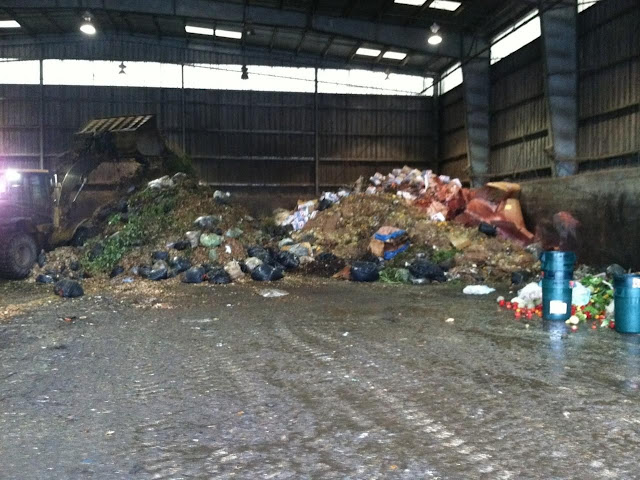
Industrial compost facility, Wilmington, Delaware

Our commercial customers don't get compost back, but our residential can get back a certain amount each year, depending on how much we produce. This year we'll be giving interested customers about ten gallons of compost back.

Is it stinky working with compost? Is it a job for everyone?

I don't think anything's a job for everyone. Anytime you're talking about food waste you're talking about, you know, garbage, and there's certainly gonna be smells involved with that. But the finished product isn't really stinky. It has sort of a natural earthy smell, like a a good forest soil smell if you were walking through a forest. But in order for it to get to that point it has to go through a phase.

When you're actually doing the composting, if you're doing it right, you shouldn't have a lot of smells. As long as you're getting enough oxygen in there, the breakdown should be aerobic as opposed to anaerobic. So it shouldn't be producing methane as a by product, and methane is what you're smelling when you're smelling rotting garbage.

And other things... Moving along, you recently won an award from the Fox School of Business and you gave a presentation at Ignite Philly. Tell us about those situations, and what role do such enterprise support groups have in helping your business?

Well, the award from Temple was part of their annual business competition, and it's open to anyone with an affiliation with Temple. Since I'm an alumni, I was open to that. I won first prize in their social entrepreneurship category. That was great because we got exposure to different kinds of people who may not have been aware of what we were doing. And also it came with some cash and other prizes that were helpful for building the business.

In terms of Ignite Philly, that was a little bit different, a different type of crowd - a less corporate and kind of a young, hipper crowd. The event really highlighted some of the interesting things going on in Philadelphia neighborhoods. So that was another good venue to get out there and promote what we're doing. I think either of those types of events where you can highlight some of the interesting stuff, the cool stuff, is helpful for all businesses. But it's also helpful for the city to show some of the positive things that are coming out.

Speaking of positive things, compost companies are seen as sustainable businesses. How do you see the outlook for sustainable businesses and green jobs in Philadelphia?

I think there's a lot of optimism around sustainable businesses and green jobs in Philadelphia. There's a lot of interesting things going on. But any business needs to be run like a business, so you need to make sure that you have a market, and that you're reaching that market, and that you're keeping your costs under control. If you don't treat it like a business, I don't think it'll be good. There is a receptive clientele and you need to demonstrate the value in it for them, whether that value is monetary savings or other kind of value. If you can show that value, people will respond to that.

There's no magic bullet - green jobs aren't going to replace all the manufacturing jobs that were lost. There's no single simple solution like that. It's all a part of it. I think there's a growing awareness of the importance of sustainability and the growing benefits both monetary and non-monetary that it can bring.

Great. Very informative. Thanks for your time.

You're welcome.


More info about Bennett Compost and the services offered can be found at www.bennettcompost.com.

---------------
Enhanced by Zemanta

Thursday, March 22, 2012

Hands On With Green City, Clean Waters

     
PWD staffer discusses stream restoration.
Water is energy, it is a source of life. In the past few weeks I've had the opportunity to examine that life source a bit more closely through an innovative outreach effort called the Green City, Clean Waters Ambassador Program from the Philadelphia Water Department and the Pennsylvania Environmental Council.

The program aims to create a new partnership to promote green infrastructure education and stewardship in Philadelphia neighborhoods. With a boost of hands-on training by specialists from the water department and various other related organizations, a group of community leaders from designated civic associations will emerge to become Green City, Clean Waters Ambassadors.

More specifically, the program focuses on storm-water management, including development, care and advocacy for sustainable landscape projects or green tools, such as tree trenches, bump-outs, bioswales, rain gardens, infiltration trenches, green roofs, and others, as part of the city's innovative initiative to reduce contamination from sewer runoff. It also integrates issues such as stream restoration, soil conservation, and other regenerative processes that are essential for maintaining healthy urban ecosystems.

A real bioswaleA real bioswale (Photo credit: Steven Vance)
Green infrastructure improvements.
Unlike many big ticket urban approaches to water reclamation that often involve major ovehalls of grey infrastructure, this program utilizes an interactive union of mother nature, the water department, and people power to make it all work. The end result is to give our local communities a sustainable development initiative that is light on the taxpayer's wallet, promotes community engagement and access, and creates a cleaner, more beautiful city. It's a very Philadelphia-like, neighborhood-minded solution to an issue that's troubling much of the nation these days.

An ambassador, huh? Perhaps. That certainly sounds prestigious. In any case, I think I'd fit the bill just fine sporting a white suite and fedora... More on this development in the coming weeks. --D.A. DeMers

For additional info on green infrastructure improvements and the Green City, Clean Waters Ambassador Program visit www.phillywatersheds.org.

---------------


20 Years of Energy Star Savings 


Hard to believes that it's been that long. Seriously, like 20 years long. But let's not dwell to much on that. Instead let's think of the many good ways the Energy Star program has helped people save on energy costs while in their homes and offices. EPA Administrator Lisa P. Jackson had some special words commemorating the anniversary in a recent blog post in the Huffington Post. Happy anniversary, indeed.  Read More.

To see a great YouTube video on the history of the Energy Star program, click here.

---------------


Energy Efficiency Made Easy


Eric Barendsen, a communication specialist at the US Department of Energy's Energy Efficiency and Renewable Energy Communications and Outreach Office, cuts to the chase with an Energy Saver's blog post on how he saved big with heating bills this winter. He also explains how that rolls into spring and summer. Best of all, he's got some quick and easy tips.  Read More. 

---------------


Putting solar to work for your home


Photovoltaic cells produce electricity directl... (Image: Wikipedia)
Photovoltaic cell.
Michigan home remodeler and instructor Steve Bredernitz sheds some light on the investment to saving ratio of his made in the USA home solar project, and how to get a solar system up and running quickly. This and more are reasons why he's gives thumbs up for solar. Post via Greenspiration Home:

"Just over a year ago, I was meeting with some fellow remodelers and we were talking about quirky clients, our teenage kids, and renewable energy. A few of these gentlemen had solar arrays and wind turbines at their homes and spoke highly of the benefits.  Others at the table were adamant that renewable energy was not cost effective. One remodeler in particular commented how solar was a horrible idea in the 1970s and is a horrible idea today. That was the moment I decided to act!Read More.

---------------
 

Up next week on Home Science, we'll check in with a few Philadelphia sustainable businesses that are making good for the community while making smart business sense. Plus, more on solar products for your home. Stay tuned.


Related articles
Enhanced by Zemanta

Wednesday, December 14, 2011

How Many Congressmen Does It Take To Change A Light Bulb?


Image of a dimmable spiral intergrated CFL.Image via Wikipedia
Compact Florescent Lamp
Quite a few, apparently, because congress has battled incessantly over the "constitutionality" of implementing the nationwide industry shift to energy-saving Compact Florescent Lamps (CFLs). The change is finally scheduled to come about this January, barring a last-minute attempt to derail the measure.

The facts are clear and extremely important in this energy and carbon challenged era: If every household in the US would switch to CFL or LED usage, it would be the equivalent of taking one million cars off our roadways. There are a multitude of reasons for the change such as this.

Likewise, the EPA ran a great post this week on their Greenversations blog, which highlighted the efforts of one astute woman who understands the significance and is taking matters into her own hands (literally) by making sure that her home lighting is thoroughly energy smart. Even her daughter is in the know about home energy conservation.

So let's see - a bright-minded child versus a House full of bickering congressmen. I'll go with the kid's advice any day.  Read More

------------


Being The Change, From The Ground Floor Up.
  

Yikes web design's eco efficient new digs.
Fishtown people can be nosy neighbors. Maybe it's because we're watchful folk who look out for each other. Or perhaps it's that we have an insatiable and profound curiosity for the world around us that leads us to snoop a bit.

Whichever the case, when YIKES, a sustainable web design business and certified B corporation, hung out their sign on Girard Avenue, I felt that curiosity rise - especially after hearing that Philadelphia Mayor Michael Nutter had attended the grand opening of their eco-fabulous new office.

What is sustainable web design? What is a B corporation? And why does the mayor like them so much? YIKES co-founder Tracy Levesque sat down recently with us to answer these questions and more. Her dreams and goals tell of a wonderful story well on its way to coming true.   Read More

---------
Enhanced by Zemanta

Monday, October 10, 2011

New Living


HoustonImage by brunosan via Flickr
The Texas flag flies in Houston.
A green building store in the Lone Star State shows how to build a healthy home, and a good business too.
 

Recently, I received a visit from my cousin Amanda Claire DeMers of Houston, who was in Philadelphia to see some of our great historic sites. I've known that she's been involved with the acclaimed store, New Living, which is an eco-smart, green building hub for Houston's sustainability sphere, and a certified "B" corporation. So after a little family catch-up chat at Johnny Brenda's restaurant and pub here in the Fishtown neighborhood of Philly, we discussed some of the innovative work that she and the store has been doing back in her hometown.


How long have you worked for New Living?

I have been at New living for two months, but New Living has been around for two years. I came in with a background in environmental policy, my Master's was on fisheries management, so completely not to do with design or retail or marketing or anything like that. But I met the owners and we got along. I came on and have been working retail there for the past couple months, but I'll be doing some PR and marketing for them - press releases and such, social media maintenance, and then a lot of events in environmental education.

Tell us about New Living - what they do, their history.

New living is a store in Houston and their niche is healthy green building and home. They sell all kinds of home-building products, like counter-tops, flooring, and they also sell organic mattresses and bedding. And then next door, which is actually part of our store but has a different storefront, is a shop called The Green Painter. That opened up six or seven month ago as a split off from New Living, and they sell no-VOC paints, non-toxic glues, wood stains, and concrete stains.

So all of our products are non-toxic and they're all environmentally friendly. But a lot of the emphasis is on the non-toxic. Much of that, to some degree, is because Houston hasn't necessarily been a very green conscious city, and when New Living moved in they thought they were going to be this sort of green store with a straight environmental message. Houston wasn't as responsive to that message as they envisioned, so they started learning more about indoor air quality and health and promoted those ideas, which sometimes goes along with environmental certifications like LEED, though sometimes it's independent. In fact, sometimes it's the opposite - a lot of LEED certification buildings trap the air inside, so they've really embraced the non-toxic banner and it seems to have resonated well.

You bring up a good point. As a trained energy auditor, my focus is often on sealing the "envelope of the home" to improve energy efficiency. We check for high CO levels in furnaces, mold, lead paint, asbestos, pet dander and other potential indoor air quality threats, but there are a multitude of contaminants to consider. We have to be very conscious of toxins as we tighten up homes.


Sustainable EditionImage by Scoobyfoo via Flickr
Non-toxic materials
Yes, and we can start that by not bringing as many toxins into the building process, which is the significance for having  formaldehyde-free flooring, and surfaces that are antimicrobial and naturally bacterial resistant and don't contain chemical dyes, and wool carpets that don't contain synthetic coatings on them. When you don't bring these toxins into the home to begin with, you start at a much easier place. Then you can begin to manage it with something like an air filter, either for a whole home or maybe just one room. We also sell air filters and water purifying systems.

It seems like it takes more than just standard marketing and offering healthy green products to make your business thrive. You've moved into channels of New Media to advocate your concept. Tell us more about the advocacy side.
  
They've always done pretty well as a business, because, for whatever reasons, Houston as a city is doing well. So we do have customers that have the money to spend on quality home products. The key is making sure we educate people about why our products are the better choice. And there will be a greater role for the educational and advocacy component through time.

We're actually not just a store, we're a certified "B" corporation or benefit corporation, which is a certain way that we're chartered to serve the long term interests of the shareholders and to help solve social, economic and environmental problems, rather than just immediate returns to investors.

lime green accentsImage by ooh_food via Flickr

So this falls in line with business concepts that have been described as an emerging new economic model: A business that's sustainable and socially responsible, but profitable too.

Certain states already have programs in place that to certify and encourage B corporations. And hopefully, someday, it would be nice if there was some sort of tax advantage too. So say, instead of being a non-profit or, well, an oil corporation - somewhere between BP and Oxfam - we could find a place where we received some government benefit of taking on these problems.

Aside from providing non-toxic home products and educational outreach, what other services does New Living offer? Do you work directly with contractors?

Yes, and that's something that's really cool about our business. Downstairs is the store and showroom, but upstairs is sort of this green business incubator, where we have several green designers, an urban renewal realty program, green architects, and a solar company. It's really a hub of green activity in Houston and we've worked hard together to make a green scene here.

That's interesting. Houston doesn't come to mind as top on the list of cities with a strong sustainability community, like say here in Philly, where our mayor has been pushing to make this the greenest city in the nation. How would you compare Houston to others?

Bill McKibben. Image: Wikipedia
Some people say that it's behind major cities, but it's caught up pretty fast. Because we have some money here, it's been able to escalate more quickly.

Actually, one of our main customer components is moms. Sometimes even mom's who's husbands work for a big oil company or in the chemical industry, but they've read some of the popular Michael Pollan, Bill McKibben type books and they're saying "you know, I don't want to bring bad things into my home." Just like the local foods and organic foods movement caught on big partly because moms were afraid of what they were feeding their kids, we're hoping that non-toxic mattresses and organic flooring will follow.

I hope so too. Thanks for stopping by and giving a word to our readers about New Living and your great city. I hope you were able to take in some of the famous sites here as well.--D.A DeMers.

Enhanced by Zemanta

Friday, August 26, 2011

Weathering the Storm

And not just talking about hurricanes.

While we here on the East Coast hunkered down for the worst from Hurricane Irene, I noticed another storm on the radar not so immediately apparent, but important to watch, nonetheless. The green-building world is coming under siege, and anything related to making the planet a healthier place is being portrayed by some as tantamount to communism, failure, or perhaps even treason.

Sustainability backlash? Image: Wikipedia
OK, maybe not treason. But here's the situation: Recently the New York Times, typically a refuge for environmentalism in the mainstream media, published an article essentially calling the green jobs sector a colossal failure. The article enigmatically tossed aside contrary findings from a prior Brookings Institute report of "explosive growth" in the sector.

Perhaps the Times felt Brookings was off because it included workers in public transportation, green tech media, eco-smart retail, and sustainable restaurants in their green jobs assessment. Or maybe they were just feeding from the same trough as other media pundits, filled with endless tales of the mismanaged Seattle weatherization program or non-stop stories of Solyndra. Whatever the case, the newspaper has been blasted by the sustainability sphere, which believes that these jobs should be recognized as part of the new green economy, a sentiment echoed prominently Wednesday in a scathing rebuttal from activist and former White House adviser Van Jones.

Hurricane Irene, Philly.
Thus, to help the understaffed NYT correct its poorly researched argument (which has now gone nearly viral in the investment world and elsewhere), Home Science will feature a series of stories of everyday Americans working hard to build a sustainable green economy while making a living.

Our next post includes a visit with Philly musician Mark Snyder at his day job with an innovative Delaware compost company that gathers recyclable waste from local restaurants. Plus we're queued up to talk with some friendly folks who run a thriving eco home furnishings store in Houston - examples of sustainable businesses that are not running for cover. Call them truck drivers, salespeople, roofers, energy auditors, weatherization installers, app-makers, or IT specialists - if they're working for a business that specializes in improving the environment and getting paid for it, I call them green jobs people. Seems clear as spring water to me.--D.A. DeMers.


The Empire State Building: A Beacon for America's Energy Independence.  By Christina Nunez via National Geographic's Great Energy Challenge blog.

Many conversations at the American Renewable Energy Day (AREDAY) conference in Aspen focused on what needs to be done, what can be done realistically, and what isn’t being done to transition the United States away from fossil fuels.

Tallest green building. Image: Wikipedia.
     
So it was refreshing and inspiring to hear about something that has been done: retrofitting New York City’s Empire State Building so that it will cut energy consumption by 38.4 percent, creating jobs and generating revenue in the process.

Amory Lovins of the Rocky Mountain Institute, who consulted on the project, and building owner Anthony Malkin discussed the retrofit at AREDAY Friday. Malkin said that the goal for the project was to go beyond “green building” standards that don’t address economics and lead to a chase for “points”: “Put bike racks and a shower in [your building], get three points. Put in a green wall with plants and a water feature in your lobby, get points.”   Read More...


Support Philly's Sustainable 19125 Community InitiativeSourced via the New Kensington Community Development Corporation.

NKCDC office.
The people from Sustainable 19125 made a great YouTube video about all the green practices taking place in our local Philly neighborhood. Help them promote this community-led initiative by taking a moment to watch the video, hit "Like", and leave a comment! And as as noted in the organization's recent newsletter, "you may even be surprised to find a neighbor/friend making a special guest appearance." Watch it here...

Sustainable 19125 describes itself as "a broad and innovative partnership among community residents, businesses, and numerous government, nonprofit, and for profit partners to green the Fishtown, Olde Richmond, and East Kensington neighborhoods of Philadelphia." The organization states that it strives "to make 19125 the most sustainable zip code in the city." Their initiative is fostered by New Kensington Community Development Corporation, with help from the Pennsylvania Horticultural Society.
 
For more info, including green community resources, forums, and ways to get involved, be sure to visit Sustainable 19125's newly redesigned website at www.sustainable19125.org.

Other information for Philly's Kensington/Fishtown area communities, including general events and business news, can be found on the New Kensington Community Development Corporation website at www.nkcdc.org.


Stay safe and God bless.

Enhanced by Zemanta

Friday, August 12, 2011

Forever Green...

Conservation is nothing new for Vermonters.


Image: D.A. DeMers.
When I left the importing business some years ago and moved to Philadelphia, I sought out a job as a custom furniture designer for a small Vermont-based solid wood furniture maker with a showroom in Manayunk. It was a true green company, and always had been since its beginning nearly 40 years ago - something they might not have even thought about at the time. 

I've since moved into more direct green job roles in weatherization and green-building fields. But during that career phase, it was a significant change. A good change. Granted, the income and perks of working for a major player in the design world were gone. But here was the uptick - instead of traveling across the globe eight times a year to a dirty industrial sector to inspect mass-market items destined for the landfill a few years after purchase, I took train rides up to a little mill in bucolic Vermont to review beautifully handcrafted yet affordable items made from Forest Stewardship Council wood sources and built to last a lifetime. I had reduced my carbon footprint from the size of Sasquatch to that of an ant. I had turned over a new green leaf, if you will.

The possibility for major societal change regarding spending choices, support for American products, local economies, healthy buildings, and a continued path toward sustainability, is not unrealistic. Only a few years ago people would say bunk if told a home would essentially be worth little more than the brick and mortar with which it was built. In a world of uncertainties comes opportunities for change - opportunities to rebuild the American dream. Thus, take a peek at this recent article from Danielle Sacks at Fast Company on the growing concept of micro investment in local communities, which, by no coincidence, uses a small town in Vermont as the base example: 


Locavesting: Investing in Main Street Instead of Wall Street.  Via Fast Company.

What if you didn't send your money to a faceless investment bank, but instead gave it to a local business? We spoke to author Amy Cortese about local investing, where people keep their capital within 50 miles of where they live.
    
Seal of Vermount. Wikipedia.
"The crazy thing is it’s easier for most people to invest in a company halfway across the world than in their own backyard," says Amy Cortese, author of the recently published Locavesting: The Revolution in Local Investing and How to Profit From It. 
  
Cortese, a former BusinessWeek editor, got her first glimpse of the revolution in 2009, as she witnessed communities swallowed up by the hangover of the economic collapse. "Wall Street rebounded, bonuses were back, everything was looking up, but it was so starkly different on the ground, on Main Street." 

Cortese spent the next year on a journey to uncover the most innovative experiments in citizen finance around the world, from local stock exchanges to cooperatives and DIY IPOs.   Read More...


On a similar note, Jeffrey Levy's post the other day at the EPA's Greenversations blog regarding sustainable Vermont, past and present, brings fond recollections of days spent in the land of 'freedom and unity' and the long-lasting tradition there to reduce, re-use, and recycle:


The View from Vermont.  Via Greenversations.

Image: D.A. DeMers.
Ah, Vermont. Where I go to get away from my job, but also where I’m reminded of why I do my job.

Every summer, we go to “camp,” the cabin on a Vermont lake built by my wife’s great-grandfather in 1913. Think “rustic,” not “luxury.” The walls are plywood, the floors creak, there’s an abundance of spiders and usually a few mice, and it smells musty. I try to convince my daughters that spiders help keep the mosquito population down, to mixed success. When I sit up late at night reading, or we stargaze, the world outside vanishes. In other words, it’s heaven.

Camp is where we take stuff like furniture and appliances when we buy new things for home. The recliner chair where I’m sitting to write this is at least 50 years old. Some of the books on the shelves date to the 1930s. The cupboard is full of plates from when my mother-in-law grew up. People here were reusing long before we started talking about “reduce, reuse, recycle.”   Read More...


East Coast Faith-based Groups Go Green.

Philadelphia has been in the news recently due to its surge of support from faith-based groups on issues of environment and energy efficiency. This was documented nicely in an article from the Philadelphia Academy of Sciences a few month ago regarding a series of forums conducted by the Interfaith Environmental Network.

It's wonderful to see similar involvement happening elsewhere. For example, an inspirational push for clean energy by religious and other non-profit organizations appears to be emerging from our neighbors down in the DC area. This write-up from Dustin Thaler of the group Weatherize DC details the effort, originally posted last week on their blog:

    
Community Energy Purchase. Via Weatherize DC.

Philadelphia Neighborhood. Image: Wikipedia
Who knew that energy savings could be so…sublime?

The Community Energy Purchase, The DC Project’s newest brainchild, is a remarkable undertaking that includes major cooperation with the Washington Interfaith Network.

The chief goal of the Community Energy Purchase is to provide close to 40 faith institutions and nonprofits in D.C. with reduced energy rates. These lower rates will have a significant impact on the institutions’ bottom lines. Congregations, many of which remain open to receive congregants at all hours of the day, often struggle with expensive utility bills. And nonprofits, who are constantly on a mission to secure funding for their causes, will also save valuable dollars.

The Community Energy Purchase has brought these faith and non-profit institutions together, and will put up to ten energy companies in competition with each other to provide them with a cheap electricity rate.   Read More...


----------

Coming soon to Home Science - A guest blogger's tale of some unsightly experiences at work with an innovative new Delaware composting company. Hey, just because it's called clean energy or a green job, doesn't mean you wont get your hands dirty!--D.A. DeMers.

  
Enhanced by Zemanta