Showing posts with label Compost. Show all posts

Tuesday, June 5, 2012

From Brownfield to Greenfield

Liberty Lands Park.
It’s hard to tell that the two acre parcel that is now Liberty Lands Park in Philadelphia was once an industrial brownfield. And it's hard to believe that the surrounding Northern Liberties community used to be one of the only neighborhoods in Philadelphia without a public green space. Liberty Lands is now a vibrant, essential part of that community, and a symbol of what resourceful neighbors can do with a few shovels, some environmental know-how, and a commitment to making their community a better place.

What is now a park, community garden, playground and state-of-the-art model for water management was once the Burk Brothers Tannery. This former brownfield or contaminated land was made safe and usable after the hazardous materials were removed by the Environmental Protection Agency in 1987.

After the pollution from the tannery was cleaned up and the contaminated materials were subtracted, biosolids, or nutrient-rich organic materials that are a bi-product from treatment of sewage at water treatment facilities, were used to improve the quality of the land. Biosolids act as a natural fertilizer, enabling the soil to retain more water and nutrients and made it possible for the growth of a community garden, an herb garden, and the more than 180 trees that the park now features.

In 1995, a development company planned to convert the land into loft apartments. When the deal fell through, the land was donated to Northern Liberties Neighborhood Association (NLNA). Since the community didn’t have a green space, neighbors envisioned and created designs for a park. In 1996, the NLNA and the project received funding from the Philadelphia Urban Resources Project.


Trail at Liberty Lands Park

Flowers in full bloom.

By the spring of 1997, with the help of other generous donations and volunteer labor, Liberty Lands was born. The park now has partnerships with Philadelphia Urban Resources Project, the Pennsylvania Horticulture Society (PHS), Philadelphia Water Department, Pennsylvania Department of Environment Protection (PA-DEP), TreeVitalize, and the Philadelphia Mural Arts Program.

More recently, the park was selected for a storm water management project. The PHS designed the project and was funded by Philadelphia Water Department/PA-DEP with the aim of easing loads on local waste water systems. Additional community support has funded the instillation of a cistern that will allow for water efficiency and conservation as water will be diverted towards irrigation.

The storm water management system establishes methods that could be utilized across the city and once again demonstrates how Liberty Lands is a model of a sustainable green space and an excellent example of grassroots community building. (See more on Philadelphia's innovative new storm-water management and green infrastructure programs at our previous posts at Home Science and Designer In Exile).


Children's garden.
Green Infrastructure landscaping.

A Few Words with Liberty Lands Park Coordinator Liz Reed.

Many people have pitched in to turn the Northern Liberties lots into a green space. Among them is park coordinator Liz Long Reed. She and her husband William Reed, co-owner of the popular restaurant, pub, and entertainment venues The Standard Tap and Johnny Brenda's, have a great history putting together fun events at the park. Recently we chatted with Liz about her related experiences:


What do you think is the single most significant function of Liberty Lands?

I think the thing that makes Liberty Lands special is that it is versatile. It's lots of things to lots of people. Even with the addition of the stage and rain garden, we purposely thought about how it would be used when there wasn't a major music or rain event going on. We want people to explore and hang out in that area.

What, if anything, has been the biggest hindrance in making Liberty Lands what it is today?

I suppose that would be lack of funds. Regardless, I think we make the most of our time and our volunteers to keep the park safe and looking its best.

What is your favorite part of the park?

That would have to be where I get to sit back and just enjoy it with my neighbors. A close second is that we own it. If we find the ways and the means to make stuff happen, we can do what we want. Like today, my husband/dedicated park volunteer went out with three extension cords and a giant drill to fix a planter that some enthusiastic bunch tipped over and broke last year. Our neighbor will meet him later in the week with his bobcat to pick the heavy top up and place it so it can be re-cemented in place. It's our park, so we can be as creative with our time and energies as we see fit. It's like a big common back yard.

Does the Northern Liberties Neighborhood Association have any new plans in store for the park or any other other green spaces in the area?

Yes to both. We hope to build a "potty shed." A neighbor designed it to house a port-a-potty on one side and a tool shed on the other. The idea is that people then can pay an annual fee to get the combo to use the toilet, and the fees cover the maintenance contract. If, for whatever reason, it doesn't work out, then we end up with one big shed.

In addition, the NLNA got a grant to green the area from 2nd Street to Delaware Avenue along Spring Garden Street. This includes planting 50 trees on April 17th. And the Philadelphia Water Department and Philadelphia Horticulture Society have started revamping the Dough-boy pocket park at 2nd and Spring Garden as we speak. It will include new storm-water amenities.


This article was posted previously on our sister site Designer In Exile.
Enhanced by Zemanta

Tuesday, April 17, 2012

The Earthmaker

 
A local entrepreneur shows how to make a buck while making a difference with his innovative composting business.


Tim Bennett
Tim Bennett is a shrewd businessman. His schooling and work with Temple's Fox School of Business added to his natural propensity for success. But to him, developing a good business meant going a step beyond just monetary gain. He also wanted a company with redeeming social value. With a recent honorary business award under his belt, and presentations at local enterprise forums, he's sharing his knowledge of what it takes to build a sustainable business in Philadelphia. Home Science caught up for a quick word from him as well:
   
Tell us about Bennett Compost. How long have you been in operation and how did you get your start? And what services do you offer?

I started Bennett Compost in summer of 2009. We started with a focus on residential composting. It was a needed solution because if you live in a city with limited space, it's difficult to find an easy way to compost. And we wanted to help people do that.

I was doing the business part time, while working full time. After about 10 months, I was able to leave my full time job and do Bennett Compost full time. At that point we started to add commercial business as well, not just helping residents compost but helping businesses, restaurants, supermarkets, grocery stores, coffee shops - anyone who was producing food - to compost their food waist as well.

What is the general process involved in composting. Where does it go? And what does the customer get back in return?

Composting is a very natural process where you're combining nitrogen rich organic food waste with carbon rich organic waste such as leaves or wood wastes, saw dust - anything like that.

We do our composting in a couple of different ways. What we collect from our customers in the residential stuff, we compost ourselves and through a network of community gardens that are established in the city, mostly in South Philadelphia, but one or two in North Philadelphia as well.

For most of the commercial stuff we work with a farm in Montgomery County, and also a commercial composting facility in Wilmington Delaware to handle that material. So we take the material there and they compost it for us.

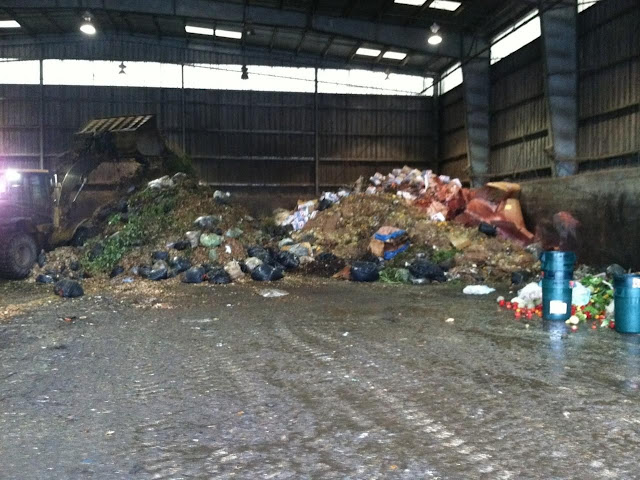
Industrial compost facility, Wilmington, Delaware

Our commercial customers don't get compost back, but our residential can get back a certain amount each year, depending on how much we produce. This year we'll be giving interested customers about ten gallons of compost back.

Is it stinky working with compost? Is it a job for everyone?

I don't think anything's a job for everyone. Anytime you're talking about food waste you're talking about, you know, garbage, and there's certainly gonna be smells involved with that. But the finished product isn't really stinky. It has sort of a natural earthy smell, like a a good forest soil smell if you were walking through a forest. But in order for it to get to that point it has to go through a phase.

When you're actually doing the composting, if you're doing it right, you shouldn't have a lot of smells. As long as you're getting enough oxygen in there, the breakdown should be aerobic as opposed to anaerobic. So it shouldn't be producing methane as a by product, and methane is what you're smelling when you're smelling rotting garbage.

And other things... Moving along, you recently won an award from the Fox School of Business and you gave a presentation at Ignite Philly. Tell us about those situations, and what role do such enterprise support groups have in helping your business?

Well, the award from Temple was part of their annual business competition, and it's open to anyone with an affiliation with Temple. Since I'm an alumni, I was open to that. I won first prize in their social entrepreneurship category. That was great because we got exposure to different kinds of people who may not have been aware of what we were doing. And also it came with some cash and other prizes that were helpful for building the business.

In terms of Ignite Philly, that was a little bit different, a different type of crowd - a less corporate and kind of a young, hipper crowd. The event really highlighted some of the interesting things going on in Philadelphia neighborhoods. So that was another good venue to get out there and promote what we're doing. I think either of those types of events where you can highlight some of the interesting stuff, the cool stuff, is helpful for all businesses. But it's also helpful for the city to show some of the positive things that are coming out.

Speaking of positive things, compost companies are seen as sustainable businesses. How do you see the outlook for sustainable businesses and green jobs in Philadelphia?

I think there's a lot of optimism around sustainable businesses and green jobs in Philadelphia. There's a lot of interesting things going on. But any business needs to be run like a business, so you need to make sure that you have a market, and that you're reaching that market, and that you're keeping your costs under control. If you don't treat it like a business, I don't think it'll be good. There is a receptive clientele and you need to demonstrate the value in it for them, whether that value is monetary savings or other kind of value. If you can show that value, people will respond to that.

There's no magic bullet - green jobs aren't going to replace all the manufacturing jobs that were lost. There's no single simple solution like that. It's all a part of it. I think there's a growing awareness of the importance of sustainability and the growing benefits both monetary and non-monetary that it can bring.

Great. Very informative. Thanks for your time.

You're welcome.


More info about Bennett Compost and the services offered can be found at www.bennettcompost.com.

---------------
Enhanced by Zemanta