Showing posts with label Philadelphia. Show all posts

Saturday, January 31, 2015

Simple Soil Mixture Reverses Toxic Stormwater Effects

Study's implications point to benefits of utilizing green stormwater infrastructure to mitigate water pollution in urban and outlying areas.

Runoff flowing into a stormwater drain. Image: Wikipedia.
Runoff at stormwater drain. Wikipedia
PUYALLUP, Wash.—A simple column of common soil can reverse the toxic effects of urban runoff that otherwise quickly kills young coho salmon and their insect prey, according to new research by Washington State University, NOAA Fisheries and the U.S. Fish and Wildlife Service.

The affordable and remarkably effective treatment offers new promise for controlling toxic pollutants that collect on paved surfaces and wash off as stormwater into rivers, streams and the ocean. Polluted stormwater has been identified as a risk factor for many threatened and endangered salmon and steelhead and has caused die-offs of coho salmon in the Pacific Northwest.

The research builds on increasingly common building practices that promote natural infiltration of stormwater into the ground. It indicates that a “bioretention” system that first filters runoff through a basic soil mixture removes toxics lethal to aquatic life. Such systems are increasingly found in Washington State’s Puget Sound area as people build “rain gardens” that trap runoff before it gets to a creek or stream.

The research published in the journal Chemosphere examined the toxic effects of runoff collected from a major Seattle highway during storms. The untreated runoff killed all juvenile salmon exposed to it within 12 hours. But all fish survived in runoff filtered through the soil column of sand, compost and bark. The soil filtration also prevented reproductive damage to tiny insects salmon eat.

“This is a simple approach that can make a big difference in the quality of water flowing into our rivers and streams,” said Jenifer McIntyre, postdoctoral researcher at Washington State University and lead author of the new research. “In this case, the salmon and their prey are telling us how clean is clean enough.”

Researchers collected runoff from a four-lane Seattle overpass during six storms and transported it to Washington State University’s Research and Extension Center in Puyallup, south of Seattle, where the experimental soil treatment columns were set up. The 12 bioretention columns were 42 inches high and contained 60 percent sand, 15 percent compost, 15 percent shredded bark and 10 percent water treatment residuals, with half also planted with a common sedge.


English: Illustration of relationship between ...
Impervious surfaces and surface runoff (Photo credit: Wikipedia)

Untreated runoff regularly killed aquatic insects such as mayflies but filtering the runoff through soil columns, with or without plants, “conferred complete protection against the lethal toxicity of stormwater runoff,” the scientists wrote. The polluted stormwater also quickly killed coho salmon, but all fish survived exposure to the same runoff after treatment.

“The positive effects on survival are really striking,” said Nat Scholz, manager of the Ecotoxicology Program at NOAA Fisheries’ Northwest Fisheries Science Center and a coauthor of the research. “This is an encouraging lesson for people working to reduce stormwater impacts to salmon habitats.”

Chemical analyses showed the bioretention treatment reduced toxic metals by 30 to 99 percent, reduced polyaromatic hydrocarbons that are byproducts of fossil fuels to levels at or below detection and reduced organic matter by more than 40 percent.

The scientists suggested that further research examine different soil mixes and the reliability of bioretention treatment over time. Additional studies could also examine whether soil filtration protects salmon from more subtle forms of toxicity, including effects on early development, the endocrine system and susceptibility to disease.

The new study is part of a longer-term research effort to develop inexpensive and effective clean water technologies. The work was funded by the U.S. Environmental Protection Agency (Region 10), NOAA’s Coastal Storms Program and the Russell Family Foundation.


Source: WSU News Washington State University.

Thursday, February 27, 2014

Rain Barrels: Small Investment, Big Benefits

Rain barrel on Philadelphia sidewalk
Winter seems to be lingering quite a bit this year, yet soon enough we'll be seeing a change to spring showers and sprouting gardens. With that in mind, it's a great time to be thinking about rain barrels - their importance in helping manage stormwater and how they can help you save on your water bill.

First, a bit on stormwater.

As communities expand with development, they become increasingly built up with impermeable surfaces such as big parking lots at big box stores. The result is that rain has few places to go; it hits the hard surfaces and just runs right off into our streams. In urban areas, stormwater management has become a critical issue because of the adverse impact from combined sewer overflows on a watershed and a city's clean drinking water. A rain barrel helps limit this because it holds that first bit of rain coming off the roof or your driveway and prevents it from running into sewers and streams and causing overflow pollution and erosion from high flows of water.

In addition to helping the environment, rain barrels enable you to harvest rainwater for use with watering plants, lawns, mopping floors, or washing cars. You don't want to use rainwater from runoff to drink or to water edibles in the garden - it may contain unknown contaminants. But there are a plethora of other uses. Likewise, as you conserve water, you'll also benefit from saving on your water bill. And in Philadelphia, the water department has gone as far as to provide free rain barrels and workshops to city-dwellers.

See the short video below from the EPA to learn more about the great dollar and environmental benefits of rain barrels - a simple and effective investment to conserve water, save money, and help the environment.


For more information about rain barrels, go to http://www.epa.gov/reg3esd1/garden/rainbarrel.html. And check out Home Science on Facebook for more articles about home energy and environment: www.facebook.com/energysmarts.
Enhanced by Zemanta

Friday, October 18, 2013

Solar Power on the Rise


Philadelphia’s Temple University To Host 63kW Solar Plant (via Clean Technica)
Temple University’s Edberg-Olson Hall will soon be home to a 63 kilowatt solar array on its south-facing roof, the school’s website reports. The plant will be built, owned, and maintained by Philadelphia-based Community Energy Inc. The power that…

Enhanced by Zemanta

Thursday, August 15, 2013

Rain Check

A pioneering outreach program empowers homeowner take on a city's stormwater troubles one house at a time.
 
Philadelphia, like most cities rests upon a vast network of underground pipes. In particular, our city has two types of sewer systems - combined and separate sewer systems - which, in total, measure 3,000 miles in length.

In areas with combined sewers, a single pipe carries both stormwater from streets, houses, and businesses as well as waste water from houses and businesses to a water treatment plant. In areas with separate sewers, one pipe carries stormwater to the city's streams while another carries wastewater to a water treatment plant.

When it rains and the amount of combined stormwater and wastewater exceeds the sewer system's capacity, the mixed stormwater and wastewater is discharged into the city's streams before it is treated - an unfortunate, but common scenario.

In the separate sewer system, stormwater is not routed to a treatment plant and is discharged directly to a stream. Pollutants picked with stormwater flow along the city's impervious surfaces and are discharged into the streams, an occurrence known as stormwater runoff.

Impervious surfaces like driveways, sidewalks, and streets prevent stormwater runoff from naturally soaking into the ground. Stormwater can pick up debris, chemicals, dirt, and other pollutants and flow into a storm sewer system or directly to a lake, stream, river, wetland, or coastal water. Anything that enters a storm sewer system is discharged untreated into the waterbodies we use for swimming, fishing and providing drinking water.

Green stormwater infrastructure includes a range of vegetation and soil systems that intercept stormwater, infiltrate a portion of it into the ground, evaporate a portion of it into the air, and in some cases release a portion of it slowly back into the sewer system.

Impervious surfaces, such as roadways and buildings, are characteristic of urbanized landscapes. As land development increases, it leads to replacement of pervious areas with impervious surfaces, causing an increase in stormwater runoff volume and combined sewer overflow episodes. In turn, this affects Philadelphia's watersheds by impairing water quality and degrading stream habitats. The Philadelphia Water Department (PWD) has established goals to protect and enhance local watersheds by managing stormwater runoff with innovative green infrastructure, maximizing economic, social, and environmental benefits for the city.

Rain Check is a program from PWD that helps residents manage stormwater and beautify their homes. Participation in Rain Check is one way Philadelphia residents can help improve local water quality and beautify their homes at the same time. Rain Check provides stormwater tools at a reduced cost to Philadelphia residents who live in the combined sewer area. These tools are landscape improvements that can beautify your home and will improve the water quality of our rivers and streams.

More on the program from the Philly Watersheds webpage:

Integrating green stormwater infrastructure into a highly developed area such as Philadelphia requires a decentralized and creative approach to planning and design. Various tools can be implemented to accomplish this, including stormwater planters, rain gardens and green roofs. All of these tools help to reduce runoff volume and filter pollutants by intercepting stormwater runoff before it enters the City's combined sewer system.

We're continuously exploring innovative ways to implement green infrastructure tools. Through our eight Land-Based Green programs, we will achieve our goals of reducing localized flooding, reducing combined sewer overflows, and improving water quality while also improving the quality of life of residents.

Contaminated water bodies are only one of many interrelated problems affected by stormwater. Stormwater volumes that exceed the sewer system's capacity can cause backups and result in street and basement flooding. Waterways and wetlands are degraded by pollutants in stormwater as natural habitats are destroyed, and biodiversity suffers. Impaired streams do not support healthy aquatic communities, do not meet uses designated by the State, do not serve as amenities to the community, and occasionally cause property damage due to flooding. When our waterways are not as healthy as they can be, we lose out on water-related recreation opportunities.

Impervious cover exacerbates the problem of stormwater when runoff flows directly into the nearest storm drain without being mitigated. If untreated before entering our waterways (including the Schuylkill and Delaware rivers, which we use as sources of drinking water), this contaminated water can have a detrimental effect on water quality.

The more impervious surfaces there are in the city, the more polluted stormwater enters the sewer system, increasing the total volume of water the city's infrastructure network must handle.The Philadelphia Water Department believes that every homeowner can make a difference in transforming Philadelphia into a green city with clean water. Rain Check gives homeowners an opportunity to reduce pollution that would otherwise end up in our creeks and rivers. For homeowners who participate in the Rain Check pilot program, PWD will help them choose a landscaping tool to manage stormwater runoff and help pay for the cost of installing the tool.

Rain Check is now in its second year as a pilot program. As part of the broader Green City, Clean Waters initiative, the services seek to help ease stormwater problems while also helping green the city. It has created awareness and shed light on such issues that were typically out of sight and mind from community stakeholders. It has also created a workforce of stormwater management specialists, which consists of a hybrid of landscape architects, environmentalists, and structural engineers in a leading-edge field for urban sustainabilty--D.A. DeMers

Saturday, January 5, 2013

Green Neighborhood Stories

By Greg Meckstroth via Keystone Edge.

A look at Postgreen: the latest on modern urban development plans for Philadelphia.

It’s not every day you meet a developer who sounds more like an urban planner than a real estate man. But the folks over at eco-friendly Postgreen fit squarely in that category—they have two projects coming soon to Frankford Avenue that exemplify a modern urban planner’s ideal: mixed-use, affordable and energy-efficient.  READ MORE


Renewing Kensington 
via Designer in Exile.

A Philadelphia filmmaker sets his sights on helping revitalize on greening and cleaning an urban community.


Philadelphia, PA 19124, 4500 block Frankford A...
Philadelphia. (Photo: Wikipedia)
Riding the elevated Market-Frankford train en route to Philadelphia's Northeast can sometimes seem like a journey across ancient Rome. Much of the Kensington neighborhood, once the brick and mortar of our nation's industrial economy, still lies in ruins from the great exodus of manufacturing jobs. It's a stirring sight: abandoned factory buildings mottle the landscape, serving as profound monuments to the city's industrial legacy.

And while some residents have fled the area, perhaps moving further northeast or to the suburbs, others have stayed to nurture and rebuild. They have found beauty amid the ruins.  READ MORE
  

Plastic Surgery Emergency for Mother Nature?
via WHDH-TV

A Massachusetts town passes unprecidented ban on sale of plastic water bottles.


Main Street from Monument Square, Concord, Mas...
Concord, MA. (Photo: Wikipedia)
Concord is the first town in the nation where the sale of plastic water bottles is prohibited. 


A new year brings a controversial new law into effect in Concord: no one can sell single-serving plastic water bottles.

“I think Concord, you know, they have a good point about the plastic. I really do and I think other towns might follow,” one woman said.

The new law is the talk of the town.

“I thought it was a joke a first but then didn't realize it was going to put in effect and then -- it’s so stupid that we can't buy water, it’s water, like come on,” said Gabe Jackson. READ MORE.


News you can surely use  
via RESNET

Energy Efficient Homes Tax Credit Extended. Lapse from expired 2011 legislation to be retroactive.


Resent Resnet Blue
(Photo: exploringfox)
RESNET has achieved its number one legislative priority when Congress extended the $2,000 tax credit for builders who build energy efficient homes by a bipartisan vote (89-8 in the Senate and 257-167 in the House).

The legislation changed the base of the tax credit from the 2003 to the 2006 International Energy Conservation Code.

The extension was part of the compromise legislation aimed at averting the fiscal cliff.  The legislation extends the credit from January 1, 2012 through December 31, 2013 and retroactively to January 1, 2012.  The credit had previously expired on December 31, 2011.

The extension of the energy efficient tax credit is contained in Section 408 of the legislation.  To down load the legislation go to American Taxpayer Act.

The legislation also extended the tax credit for homeowners to purchase qualified products to improve the energy efficiency of their existing homes.

President Obama announced that he would sign this legislation.

This is a significant achievement considering the political stalemate that has existed in Washington.  It also demonstrates that there is wide bipartisan policy support for high performance homes. READ MORE

---------------

Enhanced by Zemanta

Friday, July 13, 2012

Turning the Tide on Stormwater Overflow

ECA Program Manager Zach Popkin gives the scoop on Philly's new Rain Check residential stormwater initiative.

Most people don’t often think about sewers, rainwater, and where water goes after a flush of the loo, but the folks at the water department sure do. It’s a big problem for cities because water is a limited resource and when sewers become overburdened, it can make for a troublesome mix with drinking water, which ultimately takes energy and money to clean.

To mitigate stormwater overflow issues, cities have increasingly relied on public green infrastructure tools such as bump-outs, planters, rain gardens, green roofs, bioswales and tree trenches (such as the one pictured here in Philadelphia's Columbus Square, which can hold up to 7100 gallons of rainwater per incident).

Philadelphia, in particular, has now begun taking this approach to people's homes with a new innovative residential program called Rain Check, which involves an initiative from the Philadelphia Water Department, training and implementation from the Energy Coordinating Agency, and engagement with the city's homeowners and residents.

Thus, Home Science caught up with the ECA's Program Manager for Rain Check, Zachary Popkin, to get the word on how it's all going to work:


What's the main purpose of the Rain Check program?

Here in the city of Philadelphia, because the city is so old, we have somewhat of an antiquated sewer system. Two-thirds of the city has what we call a combined sewer system. And what that means is that the sewer pipes in our streets have a combination of stormwater from rain events combined with our waste water from our homes. And what happens is that when it rains and they reach their capacity, we have these overflows. These stormwater overflows are flowing into our waterways, and it creates pollution, it creates erosion and flooding, and basically degrades the quality of our water in terms of the cleanliness of the water as well as habitats for ecosystems, and making our waterfronts liveable and enjoyable. Through this program we hope to address the issues of both stormwater quantity and quality management and we hope to make a happier city and more friendly waterfronts.

More specifically, since this effects all Philadelphians, what sort of role can homeowners and tenants play to help? How does Rain Check allow them to participate?

The goal of Rain Check is to treat the first inch of rain from storm events on the resident's site. So we have five green tools from Rain Check. We have a downspout planter box, we have a rain garden, we have the depaving of impervious surface - so if you have asphalt or concrete we can remove that to encourage the water to naturally infiltrate back into the ground - and we have porous paving options, which is basically still hard surfaces but allows the water to penetrate into the ground. And lastly we have just your average yard tree, which helps capture stormwater but also the root systems help to filter the water.

Homeowners who are participating in the program can receive one of the tools I mentioned, plus a yard tree. So say they can get a planter and a yard tree, or they can get a rain garden and a yard tree. The way the funding works is that the homeowner will be responsible for just a small copay, and the water department will provide funding for the remaining 80-90 percent. So it's a drastically reduced cost that the homeowner will pay to get their green tool.

Since this blog is also concerned with green jobs and building a sustainable workforce, in every sense, describe the type of jobs you'll be creating and the backgrounds of people being trained for this new career field of green infrastructure.

Green tool training at the ECA
Sure. We're managing our stormwater management process similar to the same way we do our energy audit process, where we have the energy audit up front, then we have the weatherization work. At the ECA in the EnergyWorks program we do a quality assurance inspection at the end of that process. You have a three process program with the inspection, the remodeling work, and the quality assurance assessment.

With the Rain Check program we've modeled that process similarly. We've trained assessors to go out and do stormwater assessments. We're requiring that stormwater assessors have their Building Performance Institute Analyst (BPI) accreditation - that basically helps them better determine stormwater issues or opportunities as it applies to the properties and homes.

For our installers, we've trained a greater variety of installers because there's a little bit more in the variety of green tools. So the types of installers are going to be general contractors and landscapers. And we have masonry contractors for the depaving portions of the program.

Do you see this kind of work as a growth field in the future, and if so, what are the indications of that?

Absolutely. Philadelphia has become a leader in the method that it has come to address its stormwater problems. Some other cities are choosing to address the issue in the back end by increasing the capacity of pipes and at the water treatment plants. What Philadelphia is choosing to do is a little bit more innovative, by treating the problem at the source, by treating it on site. So not only are we treating the stormwater through these practices, but we're helping to beautify our city, because the planter boxes and rain gardens and trees add an aesthetic value - not only are we resolving stormwater problems but we are able to green and beautify our city through these programs.

And since Philadelphia has acted as a leader in this method for managing stormwater, we're hoping that Rain Check, and Philadelphia's stormwater program overall, which is called Green City, Clean Waters, can serve as a model for cities throughout the nation as they address their stormwater issues.

And in a cost effective way.

Exactly, particularly in Philadelphia because of the scope of our sewer system. It's prohibitive cost-wise to rehabilitate all of our sewer systems and by completely trying to address the issue of stormwater by increasing the capacity of our plants. What Philadelphia needs to do to address its type of water problems is a more comprehensive approach. While we can do some of the other things such as increasing capacity of sewer systems and treatment plants, doing things like stream restoration and public outreach, we're also going to be doing things like green infrastructure and low impact development, such as the green tools we talked about.

Sounds like a win win solution. Thanks for your time.

Thank you.


Blogger's note: The Rain Check program is in pilot phase, and currently not registering additional residents. Further opportunities to join will be forthcoming. For more on this and other programs from the Philadelphia Water Department visit www.phillywatersheds.org
---------------
Enhanced by Zemanta

Tuesday, June 5, 2012

From Brownfield to Greenfield

Liberty Lands Park.
It’s hard to tell that the two acre parcel that is now Liberty Lands Park in Philadelphia was once an industrial brownfield. And it's hard to believe that the surrounding Northern Liberties community used to be one of the only neighborhoods in Philadelphia without a public green space. Liberty Lands is now a vibrant, essential part of that community, and a symbol of what resourceful neighbors can do with a few shovels, some environmental know-how, and a commitment to making their community a better place.

What is now a park, community garden, playground and state-of-the-art model for water management was once the Burk Brothers Tannery. This former brownfield or contaminated land was made safe and usable after the hazardous materials were removed by the Environmental Protection Agency in 1987.

After the pollution from the tannery was cleaned up and the contaminated materials were subtracted, biosolids, or nutrient-rich organic materials that are a bi-product from treatment of sewage at water treatment facilities, were used to improve the quality of the land. Biosolids act as a natural fertilizer, enabling the soil to retain more water and nutrients and made it possible for the growth of a community garden, an herb garden, and the more than 180 trees that the park now features.

In 1995, a development company planned to convert the land into loft apartments. When the deal fell through, the land was donated to Northern Liberties Neighborhood Association (NLNA). Since the community didn’t have a green space, neighbors envisioned and created designs for a park. In 1996, the NLNA and the project received funding from the Philadelphia Urban Resources Project.


Trail at Liberty Lands Park

Flowers in full bloom.

By the spring of 1997, with the help of other generous donations and volunteer labor, Liberty Lands was born. The park now has partnerships with Philadelphia Urban Resources Project, the Pennsylvania Horticulture Society (PHS), Philadelphia Water Department, Pennsylvania Department of Environment Protection (PA-DEP), TreeVitalize, and the Philadelphia Mural Arts Program.

More recently, the park was selected for a storm water management project. The PHS designed the project and was funded by Philadelphia Water Department/PA-DEP with the aim of easing loads on local waste water systems. Additional community support has funded the instillation of a cistern that will allow for water efficiency and conservation as water will be diverted towards irrigation.

The storm water management system establishes methods that could be utilized across the city and once again demonstrates how Liberty Lands is a model of a sustainable green space and an excellent example of grassroots community building. (See more on Philadelphia's innovative new storm-water management and green infrastructure programs at our previous posts at Home Science and Designer In Exile).


Children's garden.
Green Infrastructure landscaping.

A Few Words with Liberty Lands Park Coordinator Liz Reed.

Many people have pitched in to turn the Northern Liberties lots into a green space. Among them is park coordinator Liz Long Reed. She and her husband William Reed, co-owner of the popular restaurant, pub, and entertainment venues The Standard Tap and Johnny Brenda's, have a great history putting together fun events at the park. Recently we chatted with Liz about her related experiences:


What do you think is the single most significant function of Liberty Lands?

I think the thing that makes Liberty Lands special is that it is versatile. It's lots of things to lots of people. Even with the addition of the stage and rain garden, we purposely thought about how it would be used when there wasn't a major music or rain event going on. We want people to explore and hang out in that area.

What, if anything, has been the biggest hindrance in making Liberty Lands what it is today?

I suppose that would be lack of funds. Regardless, I think we make the most of our time and our volunteers to keep the park safe and looking its best.

What is your favorite part of the park?

That would have to be where I get to sit back and just enjoy it with my neighbors. A close second is that we own it. If we find the ways and the means to make stuff happen, we can do what we want. Like today, my husband/dedicated park volunteer went out with three extension cords and a giant drill to fix a planter that some enthusiastic bunch tipped over and broke last year. Our neighbor will meet him later in the week with his bobcat to pick the heavy top up and place it so it can be re-cemented in place. It's our park, so we can be as creative with our time and energies as we see fit. It's like a big common back yard.

Does the Northern Liberties Neighborhood Association have any new plans in store for the park or any other other green spaces in the area?

Yes to both. We hope to build a "potty shed." A neighbor designed it to house a port-a-potty on one side and a tool shed on the other. The idea is that people then can pay an annual fee to get the combo to use the toilet, and the fees cover the maintenance contract. If, for whatever reason, it doesn't work out, then we end up with one big shed.

In addition, the NLNA got a grant to green the area from 2nd Street to Delaware Avenue along Spring Garden Street. This includes planting 50 trees on April 17th. And the Philadelphia Water Department and Philadelphia Horticulture Society have started revamping the Dough-boy pocket park at 2nd and Spring Garden as we speak. It will include new storm-water amenities.


This article was posted previously on our sister site Designer In Exile.
Enhanced by Zemanta

Tuesday, April 17, 2012

The Earthmaker

 
A local entrepreneur shows how to make a buck while making a difference with his innovative composting business.


Tim Bennett
Tim Bennett is a shrewd businessman. His schooling and work with Temple's Fox School of Business added to his natural propensity for success. But to him, developing a good business meant going a step beyond just monetary gain. He also wanted a company with redeeming social value. With a recent honorary business award under his belt, and presentations at local enterprise forums, he's sharing his knowledge of what it takes to build a sustainable business in Philadelphia. Home Science caught up for a quick word from him as well:
   
Tell us about Bennett Compost. How long have you been in operation and how did you get your start? And what services do you offer?

I started Bennett Compost in summer of 2009. We started with a focus on residential composting. It was a needed solution because if you live in a city with limited space, it's difficult to find an easy way to compost. And we wanted to help people do that.

I was doing the business part time, while working full time. After about 10 months, I was able to leave my full time job and do Bennett Compost full time. At that point we started to add commercial business as well, not just helping residents compost but helping businesses, restaurants, supermarkets, grocery stores, coffee shops - anyone who was producing food - to compost their food waist as well.

What is the general process involved in composting. Where does it go? And what does the customer get back in return?

Composting is a very natural process where you're combining nitrogen rich organic food waste with carbon rich organic waste such as leaves or wood wastes, saw dust - anything like that.

We do our composting in a couple of different ways. What we collect from our customers in the residential stuff, we compost ourselves and through a network of community gardens that are established in the city, mostly in South Philadelphia, but one or two in North Philadelphia as well.

For most of the commercial stuff we work with a farm in Montgomery County, and also a commercial composting facility in Wilmington Delaware to handle that material. So we take the material there and they compost it for us.

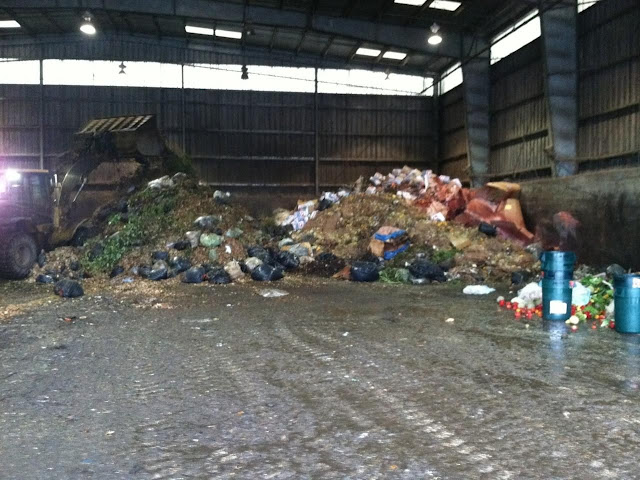
Industrial compost facility, Wilmington, Delaware

Our commercial customers don't get compost back, but our residential can get back a certain amount each year, depending on how much we produce. This year we'll be giving interested customers about ten gallons of compost back.

Is it stinky working with compost? Is it a job for everyone?

I don't think anything's a job for everyone. Anytime you're talking about food waste you're talking about, you know, garbage, and there's certainly gonna be smells involved with that. But the finished product isn't really stinky. It has sort of a natural earthy smell, like a a good forest soil smell if you were walking through a forest. But in order for it to get to that point it has to go through a phase.

When you're actually doing the composting, if you're doing it right, you shouldn't have a lot of smells. As long as you're getting enough oxygen in there, the breakdown should be aerobic as opposed to anaerobic. So it shouldn't be producing methane as a by product, and methane is what you're smelling when you're smelling rotting garbage.

And other things... Moving along, you recently won an award from the Fox School of Business and you gave a presentation at Ignite Philly. Tell us about those situations, and what role do such enterprise support groups have in helping your business?

Well, the award from Temple was part of their annual business competition, and it's open to anyone with an affiliation with Temple. Since I'm an alumni, I was open to that. I won first prize in their social entrepreneurship category. That was great because we got exposure to different kinds of people who may not have been aware of what we were doing. And also it came with some cash and other prizes that were helpful for building the business.

In terms of Ignite Philly, that was a little bit different, a different type of crowd - a less corporate and kind of a young, hipper crowd. The event really highlighted some of the interesting things going on in Philadelphia neighborhoods. So that was another good venue to get out there and promote what we're doing. I think either of those types of events where you can highlight some of the interesting stuff, the cool stuff, is helpful for all businesses. But it's also helpful for the city to show some of the positive things that are coming out.

Speaking of positive things, compost companies are seen as sustainable businesses. How do you see the outlook for sustainable businesses and green jobs in Philadelphia?

I think there's a lot of optimism around sustainable businesses and green jobs in Philadelphia. There's a lot of interesting things going on. But any business needs to be run like a business, so you need to make sure that you have a market, and that you're reaching that market, and that you're keeping your costs under control. If you don't treat it like a business, I don't think it'll be good. There is a receptive clientele and you need to demonstrate the value in it for them, whether that value is monetary savings or other kind of value. If you can show that value, people will respond to that.

There's no magic bullet - green jobs aren't going to replace all the manufacturing jobs that were lost. There's no single simple solution like that. It's all a part of it. I think there's a growing awareness of the importance of sustainability and the growing benefits both monetary and non-monetary that it can bring.

Great. Very informative. Thanks for your time.

You're welcome.


More info about Bennett Compost and the services offered can be found at www.bennettcompost.com.

---------------
Enhanced by Zemanta

Thursday, March 22, 2012

Hands On With Green City, Clean Waters

     
PWD staffer discusses stream restoration.
Water is energy, it is a source of life. In the past few weeks I've had the opportunity to examine that life source a bit more closely through an innovative outreach effort called the Green City, Clean Waters Ambassador Program from the Philadelphia Water Department and the Pennsylvania Environmental Council.

The program aims to create a new partnership to promote green infrastructure education and stewardship in Philadelphia neighborhoods. With a boost of hands-on training by specialists from the water department and various other related organizations, a group of community leaders from designated civic associations will emerge to become Green City, Clean Waters Ambassadors.

More specifically, the program focuses on storm-water management, including development, care and advocacy for sustainable landscape projects or green tools, such as tree trenches, bump-outs, bioswales, rain gardens, infiltration trenches, green roofs, and others, as part of the city's innovative initiative to reduce contamination from sewer runoff. It also integrates issues such as stream restoration, soil conservation, and other regenerative processes that are essential for maintaining healthy urban ecosystems.

A real bioswaleA real bioswale (Photo credit: Steven Vance)
Green infrastructure improvements.
Unlike many big ticket urban approaches to water reclamation that often involve major ovehalls of grey infrastructure, this program utilizes an interactive union of mother nature, the water department, and people power to make it all work. The end result is to give our local communities a sustainable development initiative that is light on the taxpayer's wallet, promotes community engagement and access, and creates a cleaner, more beautiful city. It's a very Philadelphia-like, neighborhood-minded solution to an issue that's troubling much of the nation these days.

An ambassador, huh? Perhaps. That certainly sounds prestigious. In any case, I think I'd fit the bill just fine sporting a white suite and fedora... More on this development in the coming weeks. --D.A. DeMers

For additional info on green infrastructure improvements and the Green City, Clean Waters Ambassador Program visit www.phillywatersheds.org.

---------------


20 Years of Energy Star Savings 


Hard to believes that it's been that long. Seriously, like 20 years long. But let's not dwell to much on that. Instead let's think of the many good ways the Energy Star program has helped people save on energy costs while in their homes and offices. EPA Administrator Lisa P. Jackson had some special words commemorating the anniversary in a recent blog post in the Huffington Post. Happy anniversary, indeed.  Read More.

To see a great YouTube video on the history of the Energy Star program, click here.

---------------


Energy Efficiency Made Easy


Eric Barendsen, a communication specialist at the US Department of Energy's Energy Efficiency and Renewable Energy Communications and Outreach Office, cuts to the chase with an Energy Saver's blog post on how he saved big with heating bills this winter. He also explains how that rolls into spring and summer. Best of all, he's got some quick and easy tips.  Read More. 

---------------


Putting solar to work for your home


Photovoltaic cells produce electricity directl... (Image: Wikipedia)
Photovoltaic cell.
Michigan home remodeler and instructor Steve Bredernitz sheds some light on the investment to saving ratio of his made in the USA home solar project, and how to get a solar system up and running quickly. This and more are reasons why he's gives thumbs up for solar. Post via Greenspiration Home:

"Just over a year ago, I was meeting with some fellow remodelers and we were talking about quirky clients, our teenage kids, and renewable energy. A few of these gentlemen had solar arrays and wind turbines at their homes and spoke highly of the benefits.  Others at the table were adamant that renewable energy was not cost effective. One remodeler in particular commented how solar was a horrible idea in the 1970s and is a horrible idea today. That was the moment I decided to act!"  Read More.

---------------
 

Up next week on Home Science, we'll check in with a few Philadelphia sustainable businesses that are making good for the community while making smart business sense. Plus, more on solar products for your home. Stay tuned.


Related articles
Enhanced by Zemanta