 |
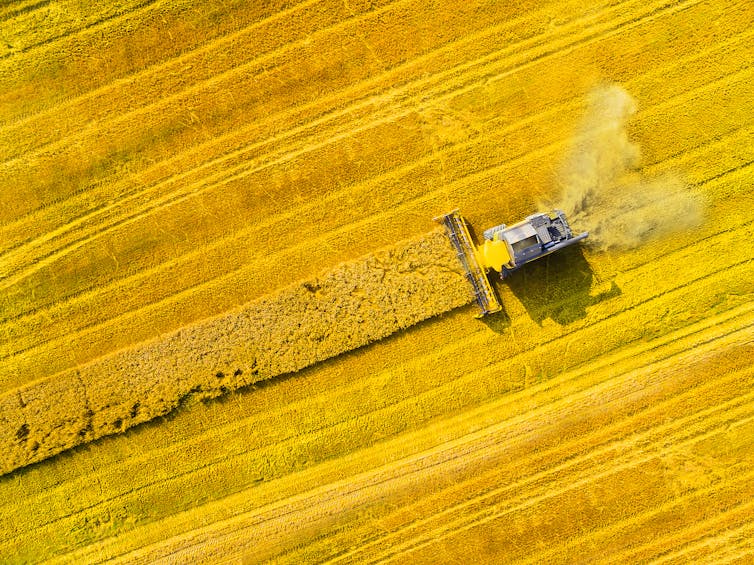
| The future of farming is ours to decide. Raggedstone/Shutterstock.com |
Most concede that there is an urgent need to radically transform our food systems. But the proposed innovations for more sustainable food systems are drastically different. Which we choose will have long-lasting effects on human society and the planet.
Suggested innovations in food systems can be broadly understood as either seeking to conform with – or to transform – the status quo.

A technological future
Some want to keep the agriculture industry as close to existing practices as possible. This is true of the increasing number of corporate and financial actors who seek to solve the food crisis by developing new technologies. These technologies are envisaged as being part of what is being called the “fourth industrial revolution” (4IR). The “answer” here is thought to lie in a fusion of technologies that blurs the lines between physical, digital and biological domains.
For example, the World Economic Forum is currently supporting agricultural transitions in 21 countries through its “New Vision for Agriculture” initiative. This initiative supports “innovation ecosystems” to re-engineer food systems based on “12 transforming technologies”. In this imagined future, next generation biotechnologies will re-engineer plants and animals. Precision farming will optimise use of water and pesticides. Global food systems will rely on smart robots, blockchain and the internet of things to manufacture synthetic foods for personalised nutrition.
Like previous green revolution technologies in agriculture, this effort is designed by and for powerful agricultural giants. These technological innovations reinforce the concentration of political and economic power in the hands of a small number of corporations. Indeed, the latter have a growing monopoly control over the “12 transforming technologies” protected by patents.
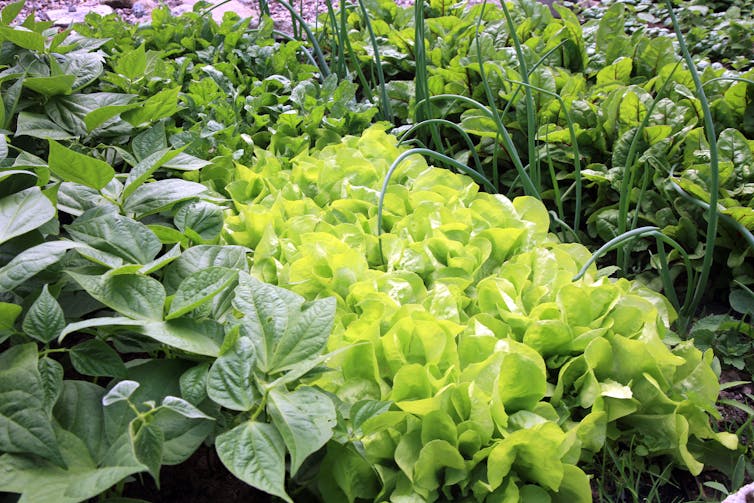 Growing multiple crops at once. Katarzyna Mazurowska/Shutterstock.com
Most notably, the spread of these technologies will expand the technosphere at the expense of the biosphere. Flying robots will pollinate crops instead of living bees. Automated machines will replace farmers’ work on soil preparation, seeding, weeding, fertility, pest control and harvesting of crops.
These hi-tech innovations radically depart from most farming practices. They are moving us towards an increasingly people-less food system. Yet they show a remarkable continuity with the logic of capitalist accumulation – hence their staying power despite their significant risks.
The spread of automated, de-localised and digitalised production and commercialisation of food is part of the “financialisation” of the global food system. Financial markets play an increasing role in controlling food systems from a distance. This generates huge social and human risks. For example, the significant growth in the sale and purchase of financial products linked to food commodities was one of the determining factors in the 2008 world food crisis.
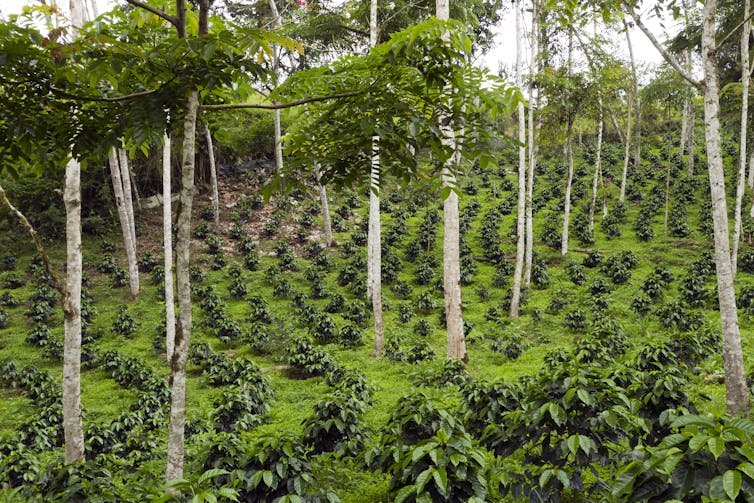 An organic coffee plantation in Ecuador. Dr Morley Read/Shutterstock.com
Another option
But there is an alternative to this future. Agroecology involves the application of ecological principles for the design and management of sustainable agroecosystems. Our research on agroecology focuses on how it can contribute to food sovereignty, which emphasises the democratisation of food systems. Agroecology’s contribution to the Sustainable Development Goals is now recognised.
In contrast to the technological vision described above, agroecological innovations promote circular systems that involve recycling, reuse and combining resources to reduce dependency on external inputs, in particular fossil fuels. They mimic natural cycles and the functional diversity of natural ecosystems.
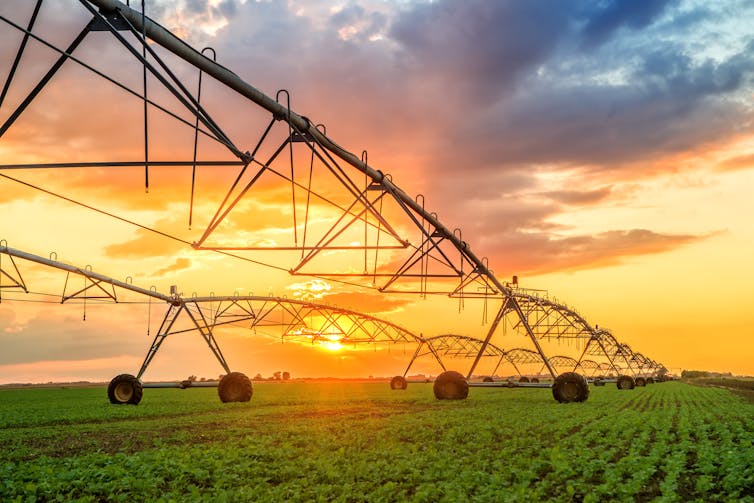 We could be seeing an extension of the megafarms we know today. Igorstevanovic/Shutterstock.com
Farming systems are designed in a way that is based on beneficial interactions between plants, animals and environments. Trees and shrubs might be planted amongst or around crops, say. Or two or more crops might be grown in proximity. Agroecology reduces the dependence of food producers on expensive external inputs, distant commodity markets and patented technologies. This is achieved by relying on appropriate biodiversity to ward off pests and increase farm yields.
At broader scales, agroecology involves circular systems that combine food and energy production with water and waste management. Pollution is minimised and synergies achieved by carefully clustering industries into functional wholes. The re-localisation of production and consumption within territories enhances local economic regeneration and sustainability.
Agroecological innovations in transitions to sustainable food systems are being driven largely from the bottom up by civil society, social movements and allied researchers. In this context, priorities for innovations are ones that increase citizen control for food sovereignty and decentralise power. This is in direct contrast to the monopoly control enabled by 4IR technologies.
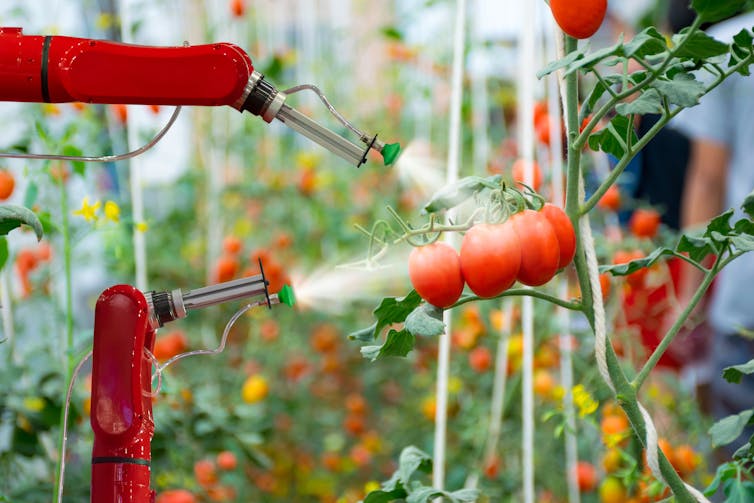 Who needs humans? Kung_tom/Shutterstock.com
 Farming systems are designed in a way that is based on beneficial interactions between plants, animals and environments. Trees and shrubs might be planted amongst or around crops, say. Or two or more crops might be grown in proximity. Agroecology reduces the dependence of food producers on expensive external inputs, distant commodity markets and patented technologies. This is achieved by relying on appropriate biodiversity to ward off pests and increase farm yields.
At broader scales, agroecology involves circular systems that combine food and energy production with water and waste management. Pollution is minimised and synergies achieved by carefully clustering industries into functional wholes. The re-localisation of production and consumption within territories enhances local economic regeneration and sustainability.
Agroecological innovations in transitions to sustainable food systems are being driven largely from the bottom up by civil society, social movements and allied researchers. In this context, priorities for innovations are ones that increase citizen control for food sovereignty and decentralise power. This is in direct contrast to the monopoly control enabled by 4IR technologies.
A democratic debate
Government, civil society and private sector representatives will soon meet in Rome at the United Nations Food and Agriculture Organization to discuss the future of farming. Who controls the global governance of innovation will be a hotly debated topic.
But given these highly contested views on innovations for food and agriculture, it is vital that everyone is able to exercise their right to have a say on the future of their food supply. Deliberative and inclusive processes such as citizens’ juries, peoples’ assemblies and community-led participatory processes are urgently needed to decide priorities for food and agricultural innovations. This is all the more important in today’s context of rapid global change and uncertainty.
So. Do you want to live in a world in which artificial food is produced by intelligent robots and corporations that put profits before people? Or one where agroecological innovations ensure we can nourish ourselves and our communities in a fair, ecologically regenerative, and culturally rich way?

Michel Pimbert, Professor and Director, Centre for Agroecology, Water and Resilience, Coventry University and Colin Anderson, Senior Research Fellow, Coventry University
This article is republished from The Conversation under a Creative Commons license. Read the original article.


