
Showing posts with label technology. Show all posts

Tuesday, November 27, 2018

The Battle for the Future of Farming: What you Need to Know

The future of farming is ours to decide. Raggedstone/Shutterstock.com 


It is widely agreed that today’s global agriculture system is a social and environmental failure. Business as usual is no longer an option: biodiversity loss and nitrogen pollution are exceeding planetary limits, and catastrophic risks of climate change demand immediate action.

Most concede that there is an urgent need to radically transform our food systems. But the proposed innovations for more sustainable food systems are drastically different. Which we choose will have long-lasting effects on human society and the planet.

Suggested innovations in food systems can be broadly understood as either seeking to conform with – or to transform – the status quo.



A technological future


Some want to keep the agriculture industry as close to existing practices as possible. This is true of the increasing number of corporate and financial actors who seek to solve the food crisis by developing new technologies. These technologies are envisaged as being part of what is being called the “fourth industrial revolution” (4IR). The “answer” here is thought to lie in a fusion of technologies that blurs the lines between physical, digital and biological domains.

For example, the World Economic Forum is currently supporting agricultural transitions in 21 countries through its “New Vision for Agriculture” initiative. This initiative supports “innovation ecosystems” to re-engineer food systems based on “12 transforming technologies”. In this imagined future, next generation biotechnologies will re-engineer plants and animals. Precision farming will optimise use of water and pesticides. Global food systems will rely on smart robots, blockchain and the internet of things to manufacture synthetic foods for personalised nutrition.

Like previous green revolution technologies in agriculture, this effort is designed by and for powerful agricultural giants. These technological innovations reinforce the concentration of political and economic power in the hands of a small number of corporations. Indeed, the latter have a growing monopoly control over the “12 transforming technologies” protected by patents.


Growing multiple crops at once. Katarzyna Mazurowska/Shutterstock.com


Most notably, the spread of these technologies will expand the technosphere at the expense of the biosphere. Flying robots will pollinate crops instead of living bees. Automated machines will replace farmers’ work on soil preparation, seeding, weeding, fertility, pest control and harvesting of crops.

These hi-tech innovations radically depart from most farming practices. They are moving us towards an increasingly people-less food system. Yet they show a remarkable continuity with the logic of capitalist accumulation – hence their staying power despite their significant risks.

The spread of automated, de-localised and digitalised production and commercialisation of food is part of the “financialisation” of the global food system. Financial markets play an increasing role in controlling food systems from a distance. This generates huge social and human risks. For example, the significant growth in the sale and purchase of financial products linked to food commodities was one of the determining factors in the 2008 world food crisis.
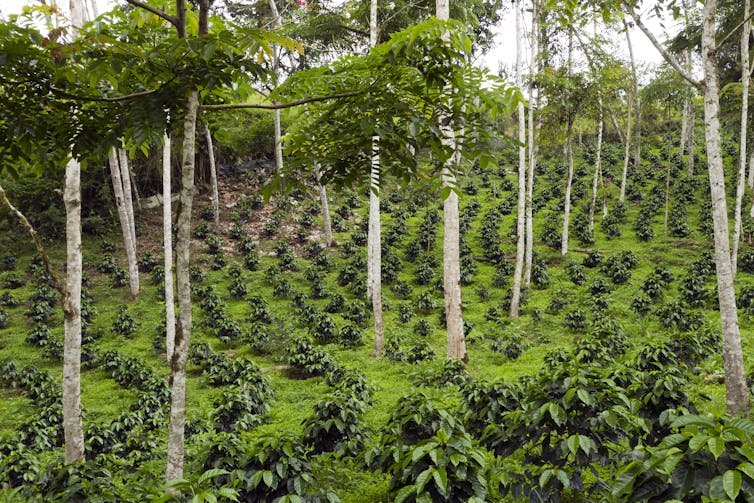

An organic coffee plantation in Ecuador. Dr Morley Read/Shutterstock.com


Another option


But there is an alternative to this future. Agroecology involves the application of ecological principles for the design and management of sustainable agroecosystems. Our research on agroecology focuses on how it can contribute to food sovereignty, which emphasises the democratisation of food systems. Agroecology’s contribution to the Sustainable Development Goals is now recognised.

In contrast to the technological vision described above, agroecological innovations promote circular systems that involve recycling, reuse and combining resources to reduce dependency on external inputs, in particular fossil fuels. They mimic natural cycles and the functional diversity of natural ecosystems. 
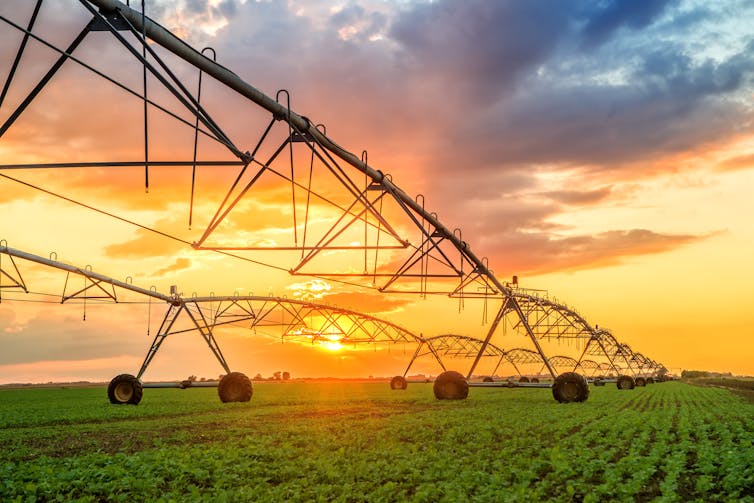

We could be seeing an extension of the megafarms we know today. Igorstevanovic/Shutterstock.com


Farming systems are designed in a way that is based on beneficial interactions between plants, animals and environments. Trees and shrubs might be planted amongst or around crops, say. Or two or more crops might be grown in proximity. Agroecology reduces the dependence of food producers on expensive external inputs, distant commodity markets and patented technologies. This is achieved by relying on appropriate biodiversity to ward off pests and increase farm yields.

At broader scales, agroecology involves circular systems that combine food and energy production with water and waste management. Pollution is minimised and synergies achieved by carefully clustering industries into functional wholes. The re-localisation of production and consumption within territories enhances local economic regeneration and sustainability.

Agroecological innovations in transitions to sustainable food systems are being driven largely from the bottom up by civil society, social movements and allied researchers. In this context, priorities for innovations are ones that increase citizen control for food sovereignty and decentralise power. This is in direct contrast to the monopoly control enabled by 4IR technologies.
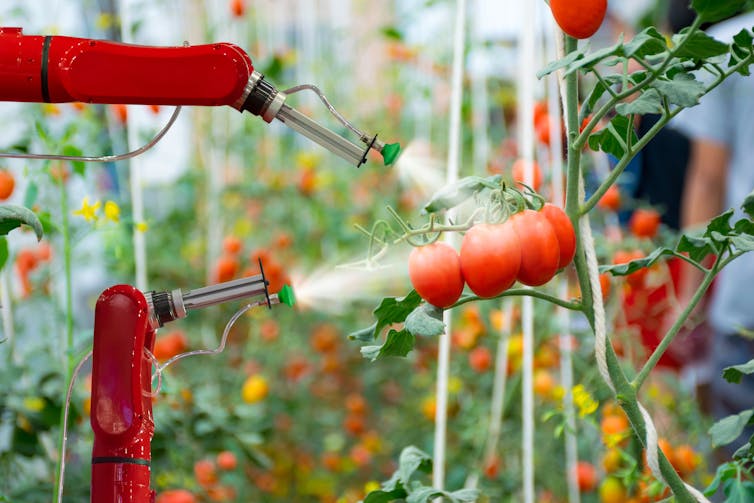

Who needs humans? Kung_tom/Shutterstock.com

Farming systems are designed in a way that is based on beneficial interactions between plants, animals and environments. Trees and shrubs might be planted amongst or around crops, say. Or two or more crops might be grown in proximity. Agroecology reduces the dependence of food producers on expensive external inputs, distant commodity markets and patented technologies. This is achieved by relying on appropriate biodiversity to ward off pests and increase farm yields.

At broader scales, agroecology involves circular systems that combine food and energy production with water and waste management. Pollution is minimised and synergies achieved by carefully clustering industries into functional wholes. The re-localisation of production and consumption within territories enhances local economic regeneration and sustainability.

Agroecological innovations in transitions to sustainable food systems are being driven largely from the bottom up by civil society, social movements and allied researchers. In this context, priorities for innovations are ones that increase citizen control for food sovereignty and decentralise power. This is in direct contrast to the monopoly control enabled by 4IR technologies.

A democratic debate


Government, civil society and private sector representatives will soon meet in Rome at the United Nations Food and Agriculture Organization to discuss the future of farming. Who controls the global governance of innovation will be a hotly debated topic.

But given these highly contested views on innovations for food and agriculture, it is vital that everyone is able to exercise their right to have a say on the future of their food supply. Deliberative and inclusive processes such as citizens’ juries, peoples’ assemblies and community-led participatory processes are urgently needed to decide priorities for food and agricultural innovations. This is all the more important in today’s context of rapid global change and uncertainty.

So. Do you want to live in a world in which artificial food is produced by intelligent robots and corporations that put profits before people? Or one where agroecological innovations ensure we can nourish ourselves and our communities in a fair, ecologically regenerative, and culturally rich way?

Michel Pimbert, Professor and Director, Centre for Agroecology, Water and Resilience, Coventry University and Colin Anderson, Senior Research Fellow, Coventry University

This article is republished from The Conversation under a Creative Commons license. Read the original article.

Saturday, September 28, 2013

Plastic Bag Waste Used to Make Materials for Nanotechnology

Types of Carbon Nanotubes
Types of Carbon Nanotubes (Photo credit: Wikipedia)
University of Adelaide researchers have developed a process for turning waste plastic bags into a high-tech nanomaterial.

The innovative nanotechnology uses non-biodegradable plastic grocery bags to make 'carbon nanotube membranes' ‒ highly sophisticated and expensive materials with a variety of potential advanced applications including filtration, sensing, energy storage and a range of biomedical innovations.

"Non-biodegradable plastic bags are a serious menace to natural ecosystems and present a problem in terms of disposal," says Professor Dusan Losic, ARC Future Fellow and Research Professor of Nanotechnology in the University's School of Chemical Engineering.

"Transforming these waste materials through 'nanotechnological recycling' provides a potential solution for minimising environmental pollution at the same time as producing high-added value products."

Carbon nanotubes are tiny cylinders of carbon atoms, one nanometre in diameter (1/10,000 the diameter of a human hair). They are the strongest and stiffest materials yet discovered - hundreds of times stronger than steel but six times lighter - and their unique mechanical, electrical, thermal and transport properties present exciting opportunities for research and development. They are already used in a variety of industries including in electronics, sports equipment, long-lasting batteries, sensing devices and wind turbines.

The University of Adelaide's Nanotech Research Group has 'grown' the carbon nanotubes onto nanoporous alumina membranes. They used pieces of grocery plastic bags which were vaporised in a furnace to produce carbon layers that line the pores in the membrane to make the tiny cylinders (the carbon nanotubes). The idea was conceived and carried out by PhD student Tariq Altalhi.

"Initially we used ethanol to produce the carbon nanotubes," says Professor Losic. "But my student had the idea that any carbon source should be useable."

The huge potential market for carbon nanotubes hinges on industry's ability to produce large quantities more cheaply and uniformly. Current synthesis methods usually involve complex processes and equipment, and most companies on the market measure production output in only several grams per day.

"In our laboratory, we've developed a new and simplified method of fabrication with controllable dimensions and shapes, and using a waste product as the carbon source," says Professor Losic.

The process is also catalyst and solvent free, which means the plastic waste can be used without generating poisonous compounds.

This research has been published online ahead of print in the journal Carbon.

--------------------


The above story is based on materials provided by University of Adelaide.

Enhanced by Zemanta

Thursday, September 26, 2013

Energy Department Launches Better Buildings Workforce Guidelines Project

Via energy.gov.

Energy-Efficient Windows: Technologies for the Future The Energy Department today announced the Better Buildings Workforce Guidelines project to improve the quality and consistency of commercial building workforce training and certification programs for five key energy-related jobs: Energy Auditor, Commissioning Professional, Building/Stationary Engineer, Facility Manager, and Energy Manager. These voluntary workforce guidelines will support the Better Buildings Initiative goal of making commercial buildings 20 percent more energy efficient over the next 10 years, while helping businesses and communities save money by saving energy and creating new clean energy jobs across the country.

Improving the energy and operational performance of commercial buildings requires highly-skilled and qualified workers, particularly as building technologies become more advanced. The Better Buildings Workforce Guidelines will support the development of high-quality training and certification programs built upon a clear set of industry-developed guidelines—to the benefit of workers, employers, building owners, and policymakers.

The Energy Department has enlisted the National Institute of Building Sciences (NIBS) to convene industry subject matter experts to develop the Better Buildings Workforce Guidelines. NIBS will establish a Commercial Workforce Credentialing Council (CWCC) comprised of private and public sector industry stakeholders to support this effort moving forward.

The guidelines will include an industry-validated Job Task Analysis (JTA) for each occupation, certification schemes (blueprints), and learning objectives. The Energy Department and the General Services Administration will recognize assessment-based certificate and competency-based certification programs that successfully implement the guidelines and achieve third-party accreditation.


To learn more about the Better Buildings Workforce Guidelines project, please visit buildings.energy.gov/workforce. Sign up here for the project webinar scheduled for October 17th.

Enhanced by Zemanta

Saturday, September 7, 2013

New LEDs light the way to a Brighter Future

blue light-emitting diode
Light-emitting diode (Photo: teraminato)
LED light bulbs can be brighter and more energy efficient than ever, thanks to a high performance LED driver newly developed by researchers from the Department of Electronic and Information Engineering.

The new driver powers LED light bulbs with an innovative approach called multi-level PWM (Pulse-Width Modulation), which delivers remarkable improvements in terms of light quality and energy efficiency, when compared to pulse width modulation and linear driver approaches currently used in LED products.

By traditional method of pulse width modulation, LEDs are fed pulsed current instead of steady DC. The drive current is turned ON and OFF at a rate faster than being perceptible by human eyes. Powering LEDs in pulses makes their light output easily controllable.

The research team, formed by Dr Lai Yuk Ming, Dr Loo Ka Hong and Prof. Michael Tse, gives the PWM method a new twist. The pulsed operation is redesigned in a way to maximize light output while minimizing wasted energy in the form of heat. The result is higher lumen per watt. Dr Loo Ka Hong said they achieved additional energy saving by up to 15%.

Single LED module consisting of 32x32 LED pixels

When used in a large scale application, it can save a lot of energy. The LED billboard on One Times Square in New York is a good example. The math goes like this: The giant display uses 12 million bulbs and 250 KW of power. If the billboard is on for 16 hours a day, the energy bill comes to US$18,000 a month. A 12% drop in energy consumption means US$2,160 in energy savings. That’s something to roll your eyes at.

Furthermore, it has lowered cooling requirements and needs smaller size heat sink compared to conventional methods. That means LED systems can be made smaller. With excellent dimming capability, the new MPWM driver allows manufacturers to create fully dimmable LEDs, which can be dimmed down to 0 watt of power. These superior qualities pave way for brighter, smarter and more versatile LED lighting solutions.

The world is switching to LEDs for huge environmental benefits. If all the traditional light bulbs in the world were replaced with energy-saving ones, lighting energy use could be cut by 40%, according to Worldwatch Institute [1]. The Energy Saving Trust has similar projections [2], which said the resultant carbon saving would be the equivalent of taking 70,000 cars off the road.


Council House in Perth, Western Australia, lit...
Council House in Perth, Western Australia, lit up by LED lights installed on the window frames. (Photo credit: Wikipedia)
As the greenest alternative to incandescent lamps, LEDs are a popular choice of lighting but they are not perfect. Consumers are looking for a brighter and more natural glow matching up to incandescent light bulbs. The demand for brightness is even more pronounced in high power applications such as automobile headlights and architectural lightings. LED research worldwide is looking to build a perfect substitute to incandescent. It is exciting to have advanced LED lighting with a simple solution such as MPWM that brings about significant energy saving.

Obviously, the novel technology allows a better product to be made. High illuminating performance combined with good thermal protection allowed manufacturers to create compact lighting solutions with a very high lumen output. And the additional cost is little because all of these qualities could be achieved with the use of low cost ICs. This could be music to the ear for LED manufacturers.

This innovative applied technology has already aroused the attention of the international market. Recently it has won a Gold Award at the 41st International Exhibition of Inventions of Geneva in April of 2013

Story based on materials provided by The Hong Kong Polytechnic University, via ResearchSEA.
Enhanced by Zemanta

Wednesday, September 26, 2012

Mapping for Cleaner Water

A Bethlehem, PA company shows how to set a course for less polluted waters through innovative technology.
  
It takes a lot of work for cities to provide clean water for their residents. But it's one of the most important challenges we face today. Our choices on maintaining a clean water system and protecting the watershed have a deep impact on the health and productivity of our nation. The mitigation of storm-water runoff is key to this, and the EPA's MS4 initiative, short for Municipal Separate Storm Sewer System, charts the way for municipalities to implement solutions.

To help with the effort, a new Pennsylvania company called Map Decisions, which has been accepted into the state's acclaimed Ben Franklin TechVentures Incubator program, has developed an innovative GPS software program for monitoring municipal water systems and assisting with MS4's implementation. Home Science recently spoke with Map Decision's CEO, Christian Birch, a Philadelphia native, for details:

What is Map Decisions, how long have you been together, and what is it that you seek to do or do now?

Map Decisions is a company that I recently formed in the beginning of 2012. I've worked for the last 13 years as an engineering consultant primarily supporting local governments, and I saw a great need in assisting local governments in complying with regulatory requirements - in particular one program from the EPA know as the municipal separate storm sewer program (MS4). It requires municipalities to obtain a permit to operate their storm sewer systems, and there are a lot of regulations that are creating both technical and financial burdens for local governments. We are helping local governments implement the permit. Our mission is to help governments improve their efficiency through innovative solutions. Map Decisions seems to redefine the term "moving at the speed of government." For generations that meant moving at a snail's pace. There's a lot of room for improvement. We need to inject innovation and technology and bring efficiency within our government.

Let's look at this subject a slightly different way, and let's take into consideration the EPA's MS4 mandate. The city of Philadelphia recently implemented a 25 year plan for green infrastructure. And the way we're looking at it is that we don't really have the money, the tax money to pay for the infrastructure renovations that are typically needed in big cities. Revenues have shrunk. So what we're doing through some of these mandates is possibly helping us save money. Do you see the positive aspects of green infrastructure and the EPA's MS4 program? Do you see how enacting some of these measures could really benefit cities and actually save tax money - not just from a burden point of view, but from an environmental and tax saving perspective? Do you see value in that?

Yes. There's long term value there. The goals and objectives of the EPA's program are to protect water quality. All the new regulations and the new methods for protecting water quality at the end of the day will make our communities stronger, they will save tax payers money, but there is an upfront cost.


In the last decade there's been a lot of improvement in terms of best management practices. City, state, county and federal governments are all pushing to have more sustainable design practices and preserving water quality. The engineering communities are required to implement best management practices wherever possible.

And these best management practices are part of the MS4. You have the construction phase of storm-water management, and the post construction phase. Construction phase examples are sediment basins that allow sediment in runoff to settle out so that it doesn't go into streams. Another example would be a silt fence - the 18" high fabric fences around construction sites. These are the best management practices for construction phase. Post-construction examples are rain gardens or vegetative bioswales, or porous pavement.

Those would be the so called "low impact tools" that cities and municipalities are beginning to utilize? Low impact, perhaps, because they don't require the city to dig and build larger sewer systems? It takes some of the burden off the sewer system in general by implementing these types of green tools. Is that right?


English: Illustration of a silt fence installa...
Silt fence. (Photo: Wikipedia)
Yes, and encouraging infiltration wherever possible. We need to make sure that we're not exchanging water between watersheds and we need to recharge aquifers. In cities like Philadelphia, it's very costly to expand sewer systems. These low impact solutions do two things: it prevents [cities] from having to do costly upgrades to the storm-sewer network, but it also allows them to improve water quality.

Let's focus a bit more on Map Decisions. What tools do you have to offer related to this?
 
We're developing one now called MS4 Solutions. It's an information management system. There are two basic components to it. It's a cloud based information system that allows the user to log on and have control of the information management system. The very first thing we do is allow our clients to develop a storm-water management system utilizing our software.

The second side to our system is mobile software. There are two mobile utilities that are tied to our information management system. The first is a mobile inspection utility, and the second is a mobile mapping utility. Both of our mobile utilities use location intelligence to help improve efficiency of data collection and aggregation. Some of the data the EPA is asking for can be difficult to ascertain, such as weather data - when was the last rainfall event and what was the volume of rain in the field where you're inspecting. That's nearly impossible to do when you're sitting out there with [just] a clipboard. The inspectors using our software don't have to worry about that. Once they start an inspection the on-board GPS triggers the intelligence built into our system. Things like the weather data, what watershed they're in, what are the receding waters - all of these things are automatically aggregated for the user utilizing the data models behind our software.

In the near future we will be adding additional modules to our platform that will allow customers to utilize mobile inspection and mapping features for other applications, such as roadways, water and wastewater, and building inspections.

This is primarily for monitoring the existing system or for planning and decision making?

Essentially for monitoring. The EPA wants to make sure we're not contaminating our nation's water. They're trying to encourage monitoring to prevent contamination of our waterways.

Interesting stuff, thank you for your time and good luck with your efforts.

Thank you.


Editorial note: The MS4 mandate covers a wide range of public entities to comply with the EPA's requirements, including local governments, municipal authorities, departments of transportation, hospitals and universities.This information was advised by Mr. Birch in a separate interview.


For more information on Map Decisions, LLC, visit www.mapdecisions.com or email them at info@mapdecisions.com or contact by phone at 877-277-5789.

Enhanced by Zemanta